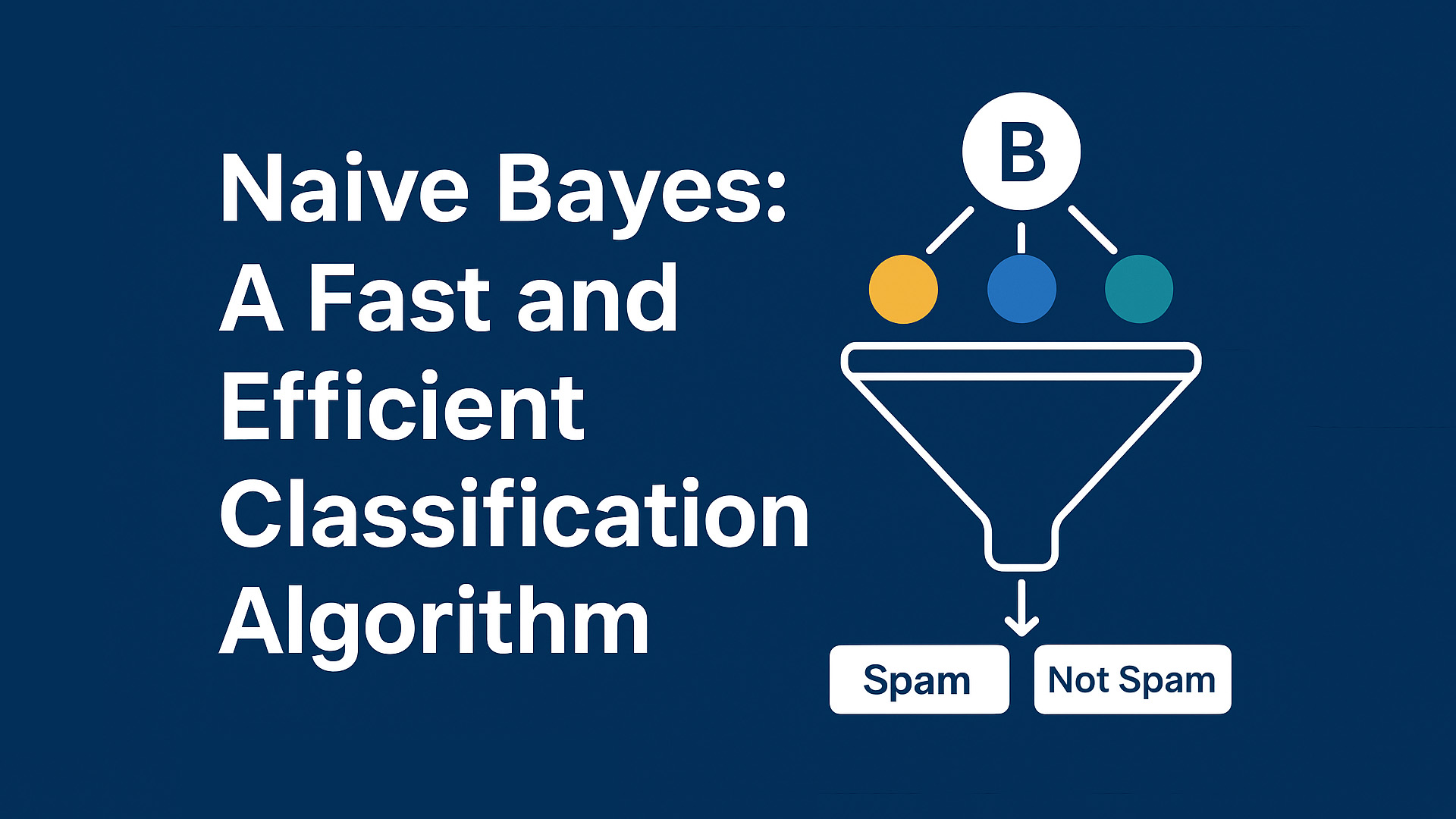
Naive Bayes: A Fast and Efficient Classification Algorithm
In the world of data science and machine learning, there are many algorithms used to process data for predictions and analysis. One of the most popular and simple algorithms is Naive Bayes.
Naive Bayes is a classification algorithm based on probability theory, particularly Bayes’ Theorem. The main principle is to calculate the likelihood that a piece of data belongs to a certain class based on the available features. It is called “naive” because the algorithm assumes that all features are independent of each other, even though in reality this is not always the case.
Why is Naive Bayes Widely Used?
-
Fast and efficient – It can handle large amounts of data in a short time.
-
Easy to understand – Since it relies on basic probability, it is beginner-friendly.
-
Great for text data – It is commonly used in spam detection, sentiment analysis, and document categorization.
How Naive Bayes Works
In simple terms, Naive Bayes calculates the probability of each class for a given data point, then assigns the class with the highest probability.
For example, in spam detection:
-
If an email contains words that often appear in spam, the probability of being classified as spam increases.
-
If it contains more common words from regular emails, it is more likely to be classified as “not spam.”
Advantages and Limitations
Advantages:
-
Fast in both training and prediction
-
Works well even with small datasets
-
Effective for categorical data
Limitations:
-
Independence assumption between features is often unrealistic
-
Less accurate when features are strongly correlated
Conclusion
Naive Bayes is a simple yet powerful classification algorithm, especially for text-based data. Despite its limitations, its speed and efficiency make it a valuable tool that remains widely used today.