Decision Tree: An Easy Way to Build Clear Prediction Models
Introduction
In the world of data analysis and machine learning, we often need models that are not only accurate but also easy to understand. One of the most popular methods for this purpose is the Decision Tree. As the name suggests, a decision tree looks like a tree, where each branch represents a decision based on certain conditions, leading to a final prediction.
What is a Decision Tree?
A Decision Tree is an algorithm used to create prediction models based on a series of simple rules. It works by splitting data into smaller groups using questions or conditions until it reaches a final decision.
Simple example:
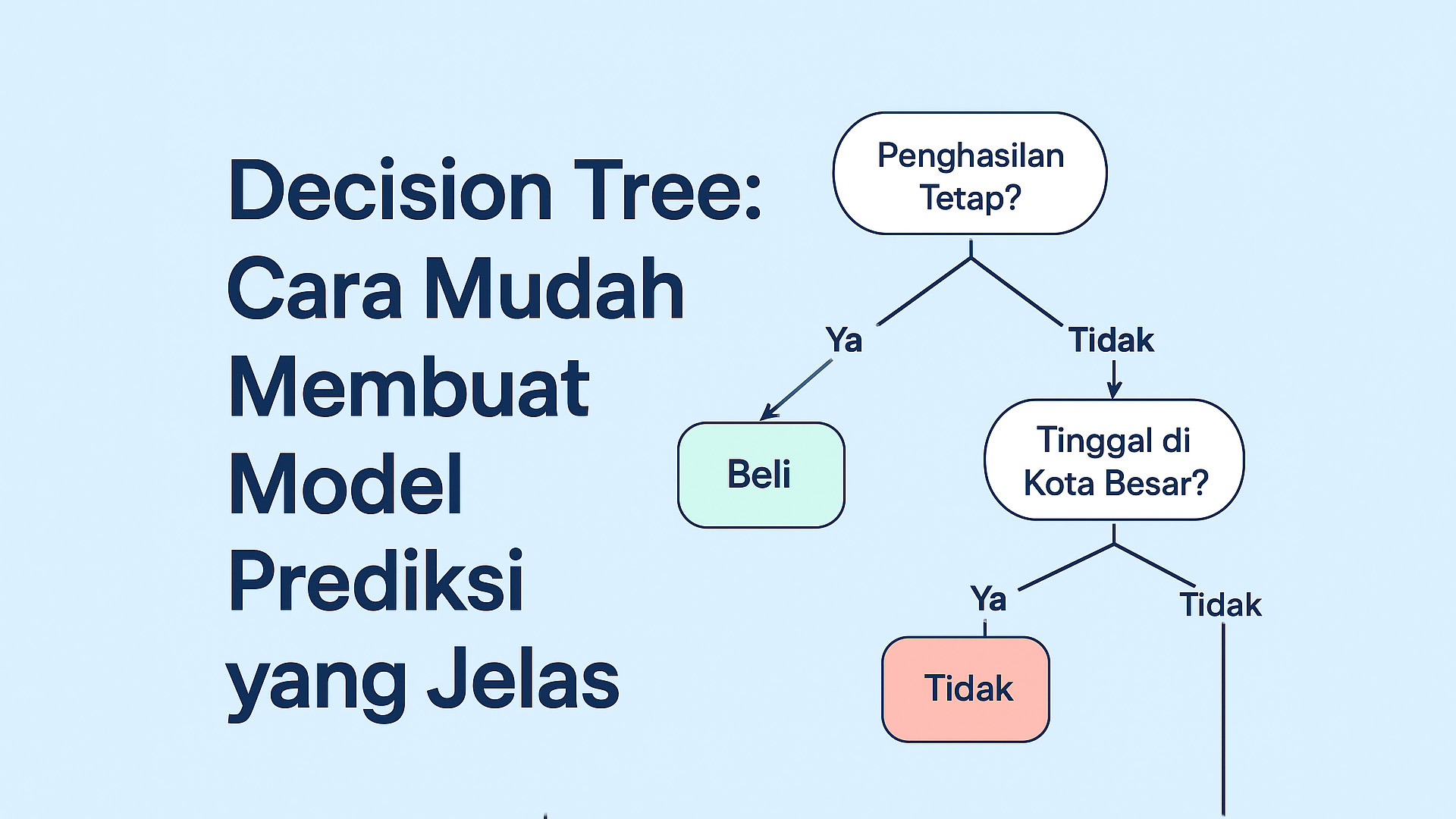
If we want to predict whether someone will buy a motorcycle:
-
Does the person have a stable income?
-
If yes, check whether they live in a big city.
-
If no, they are less likely to buy.
-
From this example, we can see how decision trees mimic human thinking in making decisions.
Advantages of Decision Trees
-
Easy to understand – results are presented in a clear tree diagram.
-
Minimal complex calculations – beginner-friendly.
-
Can handle both categorical and numerical data.
-
Fast to use for predictions.
Limitations of Decision Trees
-
Overfitting – trees can become too complex if not controlled.
-
Less stable – small changes in data may produce very different trees.
-
Less accurate on very large datasets compared to ensemble methods like Random Forests.
Example Applications of Decision Trees
-
Healthcare: predicting whether a patient is at risk of certain diseases.
-
Marketing: predicting whether a customer will purchase a new product.
-
Education: evaluating whether a student is likely to pass an exam based on past scores.
Conclusion
Decision Trees are among the most intuitive methods in machine learning. With their simple yet effective approach, they allow us to build clear and interpretable prediction models that can be applied across different fields.