Understanding the Decision Tree Algorithm and How It Works
In the world of artificial intelligence (AI) and data mining, the Decision Tree algorithm is one of the most popular and easy-to-understand methods. It is widely used for classification and prediction tasks due to its intuitive and transparent structure. This article will explain what the Decision Tree algorithm is, how it works, and the detailed methods behind it.
What Is a Decision Tree Algorithm?
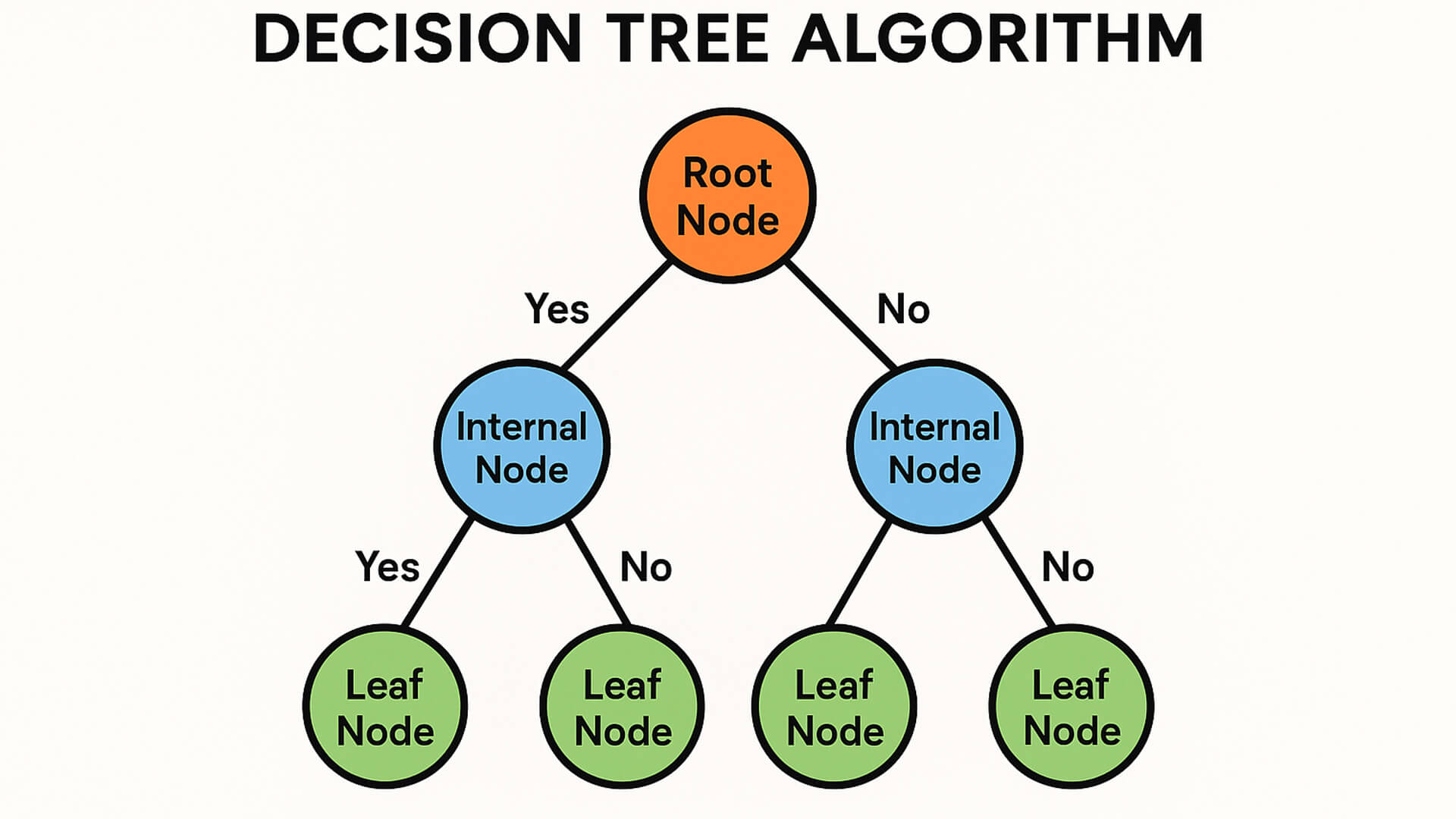
A Decision Tree is a machine learning algorithm used to solve classification and regression problems. It builds a tree-like model of decisions, where each node represents a feature (or attribute), each branch represents a decision rule, and each leaf node represents an outcome or class label.
The algorithm works by splitting data into subsets based on the most significant attributes that can best separate the classes.
Structure of a Decision Tree
A Decision Tree consists of several key components:
-
Root Node: The first node, representing the most important attribute to split the data.
-
Internal Nodes: Nodes that represent tests or decisions based on attributes.
-
Leaf Nodes: Final nodes that represent the classification or outcome.
-
Branches: The paths that connect nodes based on decision outcomes.
How the Decision Tree Algorithm Works
Here are the general steps involved in building a Decision Tree:
-
Choose the best attribute to split the dataset
The algorithm selects the attribute that provides the highest information gain, gain ratio, or gini index. -
Split the dataset into subsets
Based on the selected attribute, the data is split into branches. -
Repeat the process recursively
For each subset, repeat the attribute selection and splitting until:-
All records in the subset belong to the same class, or
-
No more attributes are available for further splitting.
-
Methods for Attribute Selection
There are several common methods for choosing the best attribute when constructing a Decision Tree:
1. ID3 (Iterative Dichotomiser 3)
Uses Information Gain to select the attribute. The higher the gain, the better the attribute.
Entropy formula:
Entropy(S) = -∑ pi * log2(pi)
Information Gain:
Gain(S, A) = Entropy(S) - ∑ (|Si| / |S|) * Entropy(Si)
2. C4.5
An improvement over ID3, C4.5 uses Gain Ratio to avoid bias toward attributes with many values.
3. CART (Classification and Regression Trees)
Uses Gini Index to select attributes, and is commonly used for binary classification.
Gini Index:
Gini(S) = 1 - ∑ (pi)^2
Advantages of Decision Tree
-
Easy to understand and visualize.
-
Requires little data preprocessing.
-
Handles both numerical and categorical data.
-
Applicable for both classification and regression tasks.
Disadvantages of Decision Tree
-
Prone to overfitting, especially with complex datasets.
-
Small changes in data can lead to very different trees.
-
May be inefficient for large datasets without pruning.
Conclusion
The Decision Tree algorithm is a powerful and intuitive method for classification and prediction. By following a logical, rule-based structure, it mimics human decision-making and is widely applied in areas such as medical diagnosis, failure prediction, and customer behavior analysis.
Understanding how Decision Trees work—including algorithms like ID3, C4.5, and CART—can help you build better, more accurate models for your data-driven projects.