Understanding the Nearest Neighbour Method in Data Science
In the world of data science and machine learning, there are various methods used for classification, prediction, or pattern recognition from a set of data. One of the simplest yet powerful techniques is the Nearest Neighbour method. This method is often used in a wide range of applications, from recommendation systems to facial recognition. Let’s take a deeper look at what the Nearest Neighbour method is and how it works.
What Is the Nearest Neighbour Method?
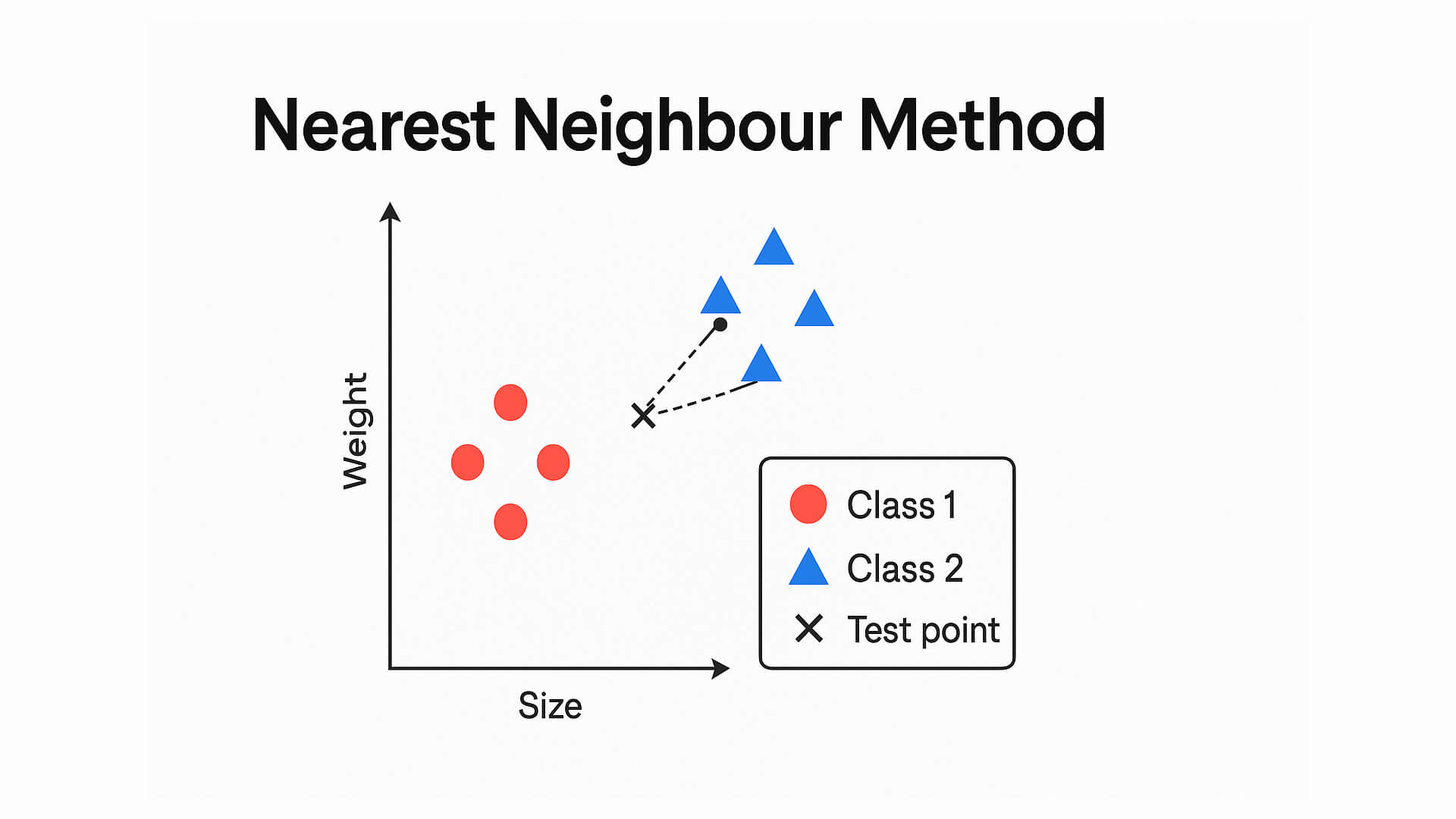
The Nearest Neighbour method is an algorithm used to classify data based on proximity or similarity to other known data points. The basic idea is very straightforward: a new data point is classified based on the data that is closest to it in the feature space.
When only one nearest neighbour is used, it is called 1-Nearest Neighbour (1-NN). In practice, however, it is common to consider multiple nearest neighbours and use a majority vote to decide the classification. This is known as the k-Nearest Neighbour (k-NN) method.
How Nearest Neighbour Works
Generally, the steps of the Nearest Neighbour algorithm are as follows:
-
Choose a value of k (the number of nearest neighbours to consider).
-
Calculate the distance between the new data point and all existing data points (using Euclidean, Manhattan, or other distance metrics).
-
Select the k closest data points based on the calculated distances.
-
Assign a class to the new data point based on the majority class among the k neighbours.
A Simple Example
Suppose we have a dataset of fruits based on their weight and size. When a new fruit comes in with certain measurements, we can use the Nearest Neighbour method to classify it as an apple, orange, or banana by comparing it to known fruits in the dataset.
Advantages of Nearest Neighbour
-
Simple to understand and implement
-
No assumptions about the underlying data distribution
-
Effective for small to medium-sized datasets
Disadvantages of Nearest Neighbour
-
High memory usage, since all training data must be stored
-
Slow prediction time for large datasets, as distances to all points must be calculated
-
Sensitive to feature scale, so data normalization is usually required
Real-World Applications
-
Movie or product recommendation systems
-
Facial and handwriting recognition
-
Fraud detection based on user behavior
-
Medical diagnosis systems based on previous patient data
Conclusion
The Nearest Neighbour method proves that simple approaches can be highly effective in real-world applications. With a good understanding of how it works and when to use it, this method can be a powerful tool in your data analysis toolbox.
If you’re just starting to learn machine learning, k-NN is one of the best algorithms to begin with before moving on to more complex techniques.