
10 Questions You Must Ask Before Hiring an App Development Company
Building an application for your business is not a small decision. An application can help companies manage data, speed up daily operations, reduce recording errors, and improve customer service.
However, the application development process does not always go as expected. Some projects are completed on time and meet all requirements, while others experience delays, unexpected costs, missing features, or applications that cannot be used effectively after delivery.
One common reason is a lack of communication between the project owner and the development team from the beginning.
Many potential clients immediately ask about pricing when contacting a developer or software house. However, price is not the only thing you should consider. There are many other important details to understand before deciding to work together.
For example, how will the development process work? Who owns the source code? Does the price include server costs? What happens if something goes wrong after launch? And can the application be expanded in the future?
These questions are important because you do not just want an application that has been completed. You need a system that can actually be used and developed according to your business requirements.
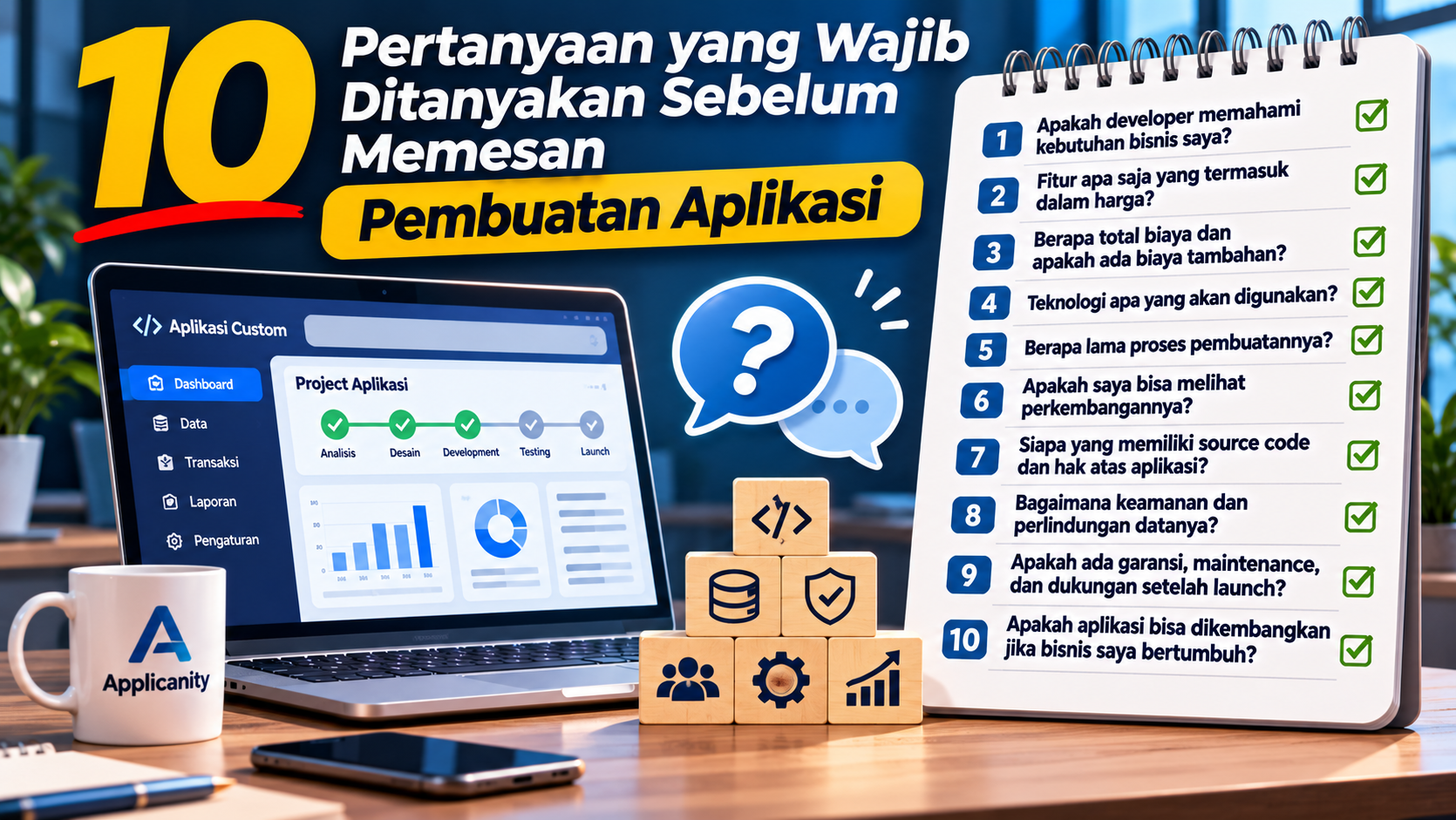
Here are 10 essential questions you should ask before hiring an application development service.
1. Does the Developer Understand My Business Requirements and Workflows?
The first question should not be about pricing. Instead, ask whether the development team truly understands your business requirements.
Every company has different ways of working. Even two businesses in the same industry may need applications with different features and workflows.
For example, a company needs an inventory management application. At first, this may sound simple because it only involves recording products.
However, after further discussion, the company may actually need several additional features, such as:
-
Recording incoming and outgoing goods.
-
Managing stock across multiple warehouses.
-
Tracking product movements.
-
Approving stock releases.
-
Receiving low-stock notifications.
-
Generating inventory reports by period.
-
Managing permissions for administrators, warehouse staff, and managers.
If developers only understand the general request without examining the actual business process, the resulting application may not meet the company's real requirements.
Questions you should ask:
-
Will the team perform requirement analysis before development begins?
-
Will the developers study our business workflows?
-
Are there discussion sessions to define application features?
-
Will the requirements be documented in writing?
A professional developer should not immediately offer a solution before understanding the problem that needs to be solved.
2. Which Features Are Included in the Quoted Price?
Once your business requirements are understood, the next step is to confirm which features are included in the proposal.
Do not simply accept descriptions such as "the application includes a dashboard and data management." Ask for a more detailed feature list.
For example, user management can include several functions:
-
Adding users.
-
Editing user information.
-
Deleting users.
-
Managing permissions.
-
Activating and deactivating accounts.
-
Viewing user activity history.
Each of these functions requires different development work.
If the project scope is not clearly explained from the beginning, you may assume a feature is included in the price while the developer considers it additional work.
This can lead to misunderstandings and unexpected expenses.
Questions you should ask:
-
Which features are included in the price?
-
How many modules will be developed?
-
Are reports and data exports included?
-
Is dashboard design part of the proposal?
-
Are external service integrations included?
-
Which features are excluded from the project?
It is best to document all features in a project scope or Statement of Work (SOW).
3. What Is the Total Cost, and Are There Any Additional Fees?
Development pricing is often one of the main considerations. However, do not focus only on the initial quoted amount.
You need to understand all possible expenses during development and after the application is completed.
Here are several cost components to consider.
Development costs
These cover requirement analysis, design, programming, testing, and application implementation.
Domain and server costs
Applications accessed through the internet need a domain name and a server to operate.
Third-party service costs
If the application uses services such as WhatsApp APIs, payment gateways, email services, or SMS OTP providers, additional charges may apply.
Maintenance costs
Applications need ongoing maintenance to remain secure, stable, and functional.
Additional feature development
If the company wants to add features outside the original agreement, those tasks may require separate payments.
Questions you should ask:
-
Does the quoted price cover the entire development process?
-
Are the domain, hosting, or VPS included?
-
Are there any subscription fees?
-
Is maintenance included in the package?
-
How are requirement changes charged?
-
Are there additional costs after launch?
Request a written cost breakdown so you can estimate the total budget rather than focusing only on the initial development price.
4. What Technology Will Be Used to Build the Application?
Technology is an important part of application development.
Web applications can be built using different programming languages, frameworks, databases, and supporting technologies.
Examples include:
-
PHP with Laravel or Yii2.
-
JavaScript with Node.js.
-
React.js or Next.js for frontend development.
-
Python with Django or FastAPI.
-
MySQL or PostgreSQL as database systems.
You do not need to understand every technology in detail. However, it is important to know what technologies will be used and why they were selected.
Technology choices can affect application performance, security, maintainability, and future development costs.
For example, an application that handles many transactions may have different technical requirements from an application used only for internal data recording.
Questions you should ask:
-
Which programming language and framework will be used?
-
Why is this technology suitable for my requirements?
-
Does the technology still receive updates and support?
-
Can the application be expanded in the future?
-
Does the system depend on specific services or technologies?
A developer should be able to explain the reasons behind technology choices in simple language, not just list framework names.
5. How Long Will It Take to Develop the Application?
The development timeline is another important detail that should be agreed upon from the beginning.
A simple application may take several weeks or months, while an application with multiple modules and integrations may require significantly more time.
However, do not only ask when the application will be finished. You should also understand the development stages.
Here is an example of a typical application development process:
| Stage | Activities |
|---|---|
| Requirement analysis | Gathering information and defining features |
| UI/UX design | Creating application screen designs |
| Development | Building the frontend, backend, and database |
| Testing | Testing features and fixing issues |
| Deployment | Installing the application on a server |
| Handover | Delivering the application and documentation |
Understanding these stages makes it easier to monitor project progress.
Questions you should ask:
-
What is the estimated development timeline?
-
What are the development stages?
-
Are there completion targets for each stage?
-
What happens if the project is delayed?
-
Can clients monitor development progress?
Make sure the agreed schedule is realistic and includes time for discussions, revisions, and testing.
6. Can I See the Application's Progress During Development?
You should not have to wait until the entire development process is complete just to see how the application works.
Choose a developer or software house that provides regular project updates.
You need to know whether the developed features match your requirements and whether there are any issues during development.
For example, developers may provide access to an application version that is still under development. This allows you to test certain features before the application is officially launched.
It also helps identify problems earlier.
If a page does not look right or a workflow needs improvement, changes can be discussed before too many application components have been built.
Questions you should ask:
-
Will an application demo be available?
-
How often will project updates be provided?
-
Can I test the application before completion?
-
How can I submit feedback and revision requests?
-
Is a testing or staging environment available?
Good communication throughout development can reduce the risk of receiving an application that does not meet expectations.
7. Who Owns the Source Code and Application Rights?
This is one of the most important questions, but it is often overlooked.
Source code is the collection of programming instructions used to build an application. With the source code, the application can be maintained, expanded, or moved to another server environment by developers with the appropriate skills.
However, not every application development agreement automatically transfers source code ownership to the client.
Some service providers deliver the entire source code, some provide limited access, and others use a licensing model.
You should understand these terms before the project begins.
Questions you should ask:
-
Will the source code be delivered to me?
-
Will I receive access to the code repository?
-
Who owns the source code?
-
Will UI/UX designs and application assets also be delivered?
-
Can I hire another developer to continue the project?
-
Are there third-party components with specific licensing requirements?
Ownership, licensing, and usage rights should be clearly stated in the contract.
This is important because you do not want to experience difficulties when changing developers or expanding the application in the future.
8. How Will Application Security and Data Protection Be Handled?
If your application manages customer information, transactions, employee records, or internal company data, security should never be treated as an optional feature.
Security must be part of the development process from the beginning.
A poorly designed application may contain several weaknesses, such as improperly protected passwords, incorrect access permissions, or vulnerabilities that allow unauthorized people to access information.
Important security considerations include:
-
Passwords stored using secure hashing methods.
-
Role-based access permissions.
-
Validation of data submitted through forms.
-
Protection against common attacks such as SQL Injection and Cross-Site Scripting.
-
HTTPS implementation.
-
Login attempt restrictions.
-
Logging of important activities.
-
Regular database backups.
Questions you should ask:
-
How will user data be protected?
-
Will the application use HTTPS?
-
How will access permissions be managed?
-
Are automatic backups available?
-
What happens if data is leaked or lost?
-
Will security testing be performed before launch?
Do not simply accept the statement that the application is secure. Ask for an explanation of the security measures being implemented.
9. Is There a Warranty, Maintenance, and Support After Launch?
Application development does not end when programming is completed.
After launch, the application may experience errors, require updates, or need adjustments to keep up with technology changes.
That is why you should understand what support will be provided after the application is delivered.
There are several types of services you should distinguish.
Bug-fixing warranty
This usually covers errors caused by development work that do not match the original agreement.
Maintenance
Maintenance includes application upkeep, component updates, security checks, and performance monitoring.
Technical support
Technical support helps users when they encounter problems or need assistance using the application.
These services are not always included in the same package.
Questions you should ask:
-
How long is the warranty period?
-
What does the warranty cover?
-
Is maintenance available after the warranty expires?
-
Is technical support available on business days?
-
How can problems be reported?
-
Are there charges for bug fixes or additional development?
Make sure the differences between bugs, feature change requests, and maintenance are clearly explained.
This helps you understand what kind of support you can expect after the application is being used.
10. Can the Application Grow Along with My Business?
The final question is about the future of your application.
As a business grows, its system requirements usually change as well.
At first, a company may only need an application to record transactions. However, as the business expands, it may want to add financial reports, warehouse management, payment integrations, and multi-branch support.
If the application is built without considering long-term development, adding new features may become difficult and expensive.
That is why you should understand whether the application is designed to support gradual improvements.
Some important considerations include:
-
Maintainable code structure.
-
Proper database design.
-
Clearly separated application modules.
-
Support for additional features.
-
Infrastructure that can scale with business needs.
-
Available technical documentation.
Questions you should ask:
-
Can the application grow into a larger system?
-
Can new modules be added without rebuilding the entire application?
-
Can the application support more users as the business grows?
-
Will system architecture and documentation be delivered?
-
What is the long-term development strategy?
A good application should not only solve today's problems but also provide room for future business growth.
Bonus: Checklist Before Hiring an Application Development Service
Before accepting a proposal from a developer or software house, use this checklist to make sure the important details have been discussed.
Requirements and Project Scope
- The purpose of the application is clearly defined.
- Business workflows have been explained.
- The feature list has been agreed upon.
- User types and permissions have been defined.
- The project scope is documented in writing.
Pricing and Timeline
- The total development cost is known.
- Additional fees have been explained.
- Domain and server costs have been considered.
- A development timeline is available.
- Payment milestones have been agreed upon.
Technology and Ownership
- The selected technology is known.
- Source code delivery terms are clear.
- Ownership and licensing terms are agreed upon.
- Technical documentation is included in the agreement.
Security and Support
- Application security has been discussed.
- Data backup has been planned.
- Testing procedures have been explained.
- The warranty period is known.
- Maintenance and technical support have been discussed.
If most of these points still have unclear answers, do not rush into accepting the proposal.
Conclusion
Hiring an application development service is not simply about choosing a developer and paying the development fee. There are many things to confirm to ensure that the resulting application truly meets your business requirements.
These include business process understanding, feature details, pricing, technology, development timelines, source code ownership, security, and support after launch.
The ten questions above can help you avoid misunderstandings and reduce the risk of an application development project that does not meet expectations.
Remember, a low price does not always mean better savings, and a high price does not automatically guarantee the best quality. Choose a service provider that can explain its workflow transparently, understand your requirements, and provide a clear development plan.
A good application is not simply an application that has been built. It is an application that genuinely helps your business operate more efficiently and grow over the long term.
Before starting a project, take the time to discuss your requirements and make sure every agreement is clearly documented. This simple step can save a significant amount of time, money, and effort in the future.