Why Small Businesses Can Now Use AI Without Their Own Data Team
Introduction
A few years ago, Artificial Intelligence (AI) was often associated with large companies that had dedicated technology departments, data scientists, and substantial development budgets. Businesses that wanted to use AI usually needed large amounts of data, specialized infrastructure, and technical experts to build and maintain their systems.
Today, things are changing.
Advances in AI technology have made it possible for small businesses to use AI without building their own data teams. Even companies with limited resources can now use AI to support everyday activities, from answering customer questions and creating marketing content to analyzing sales and managing business information.
This change is happening because many technology providers now offer AI through ready-to-use applications, cloud services, and simple tools. Business owners no longer need to understand complex algorithms or develop their own AI models to benefit from the technology.
So, what makes AI more accessible to small businesses? And how can it help companies grow without significantly increasing their workforce?
1. AI No Longer Has to Be Built from Scratch
One of the main reasons AI has become easier to use is the availability of ready-made AI models.
In the past, companies that wanted to use AI often had to develop their own models using internal data. This process required technical specialists, powerful computers, and considerable development time.
Today, many technology companies provide AI models that have already been trained using large amounts of data. Businesses can access their capabilities through applications or APIs without building everything from the beginning.
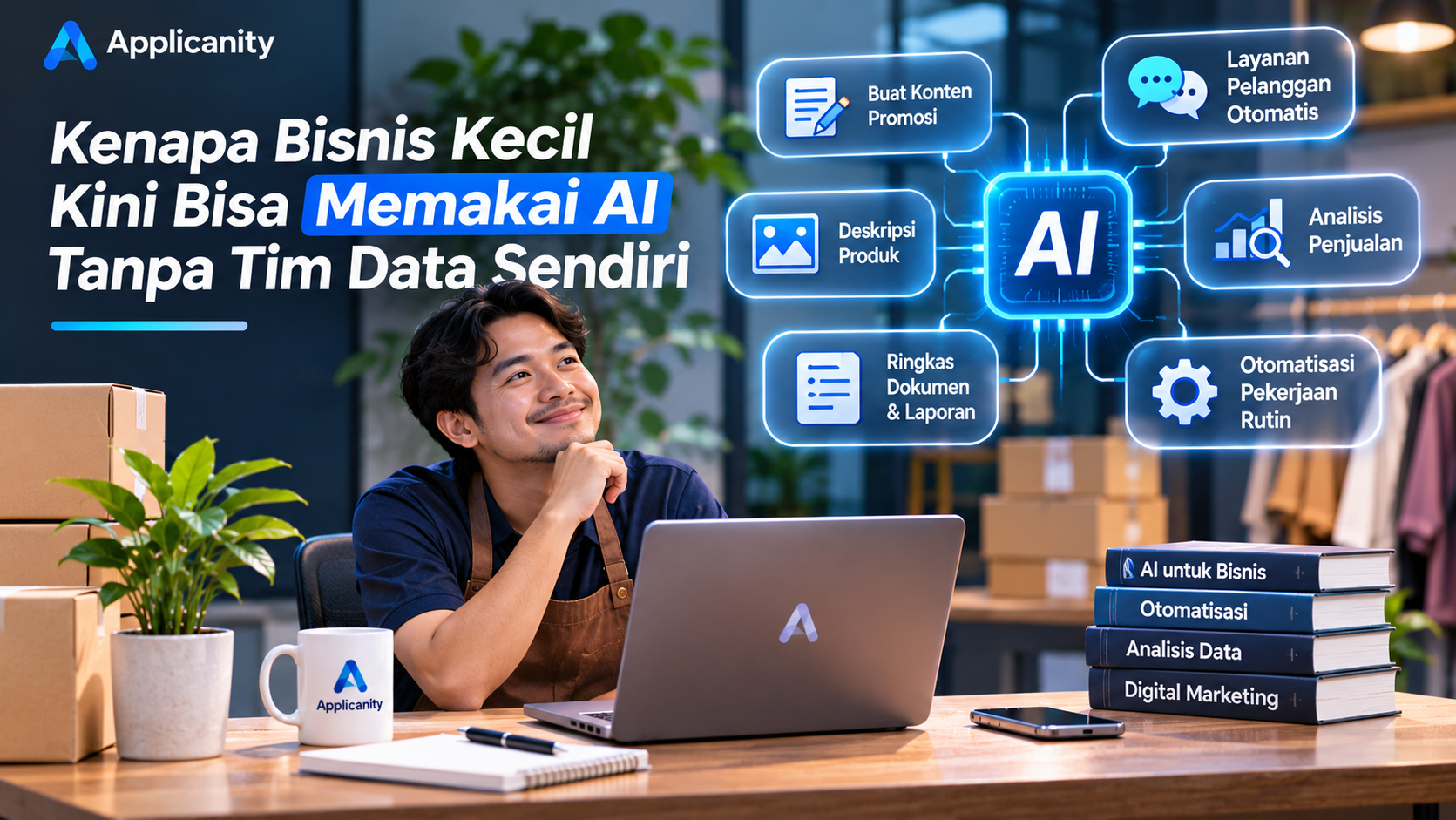
For example, small business owners can use AI to:
-
Write product descriptions.
-
Draft customer emails.
-
Summarize documents.
-
Help answer customer questions.
-
Organize customer feedback and complaints.
-
Generate social media content ideas.
With these services, businesses only need to choose tools that match their needs. They do not need to hire a data scientist or machine learning engineer just to get started.
2. Many Business Applications Already Include AI Features
AI is no longer available only through dedicated AI applications. Many software products used in everyday business operations are beginning to include AI-powered features.
These features can be found in document management tools, email services, marketing platforms, customer relationship management (CRM) systems, and accounting applications.
This means small businesses do not always need to purchase or develop a new system just to start using AI.
Here are some examples:
Marketing applications
AI can help generate content ideas, write promotional messages, suggest headlines, and adapt marketing content for different customer groups.
Customer service applications
AI-powered chatbots can answer common questions, provide product information, and direct customers to the right department.
Document management applications
AI can help read, summarize, and search business documents, making administrative tasks faster.
Sales applications
Some sales platforms provide AI features that help identify sales trends, find popular products, and understand customer behavior.
By using applications that already exist, small businesses can benefit from AI without managing complicated technology infrastructure.
3. Cloud Computing Makes AI More Affordable
Infrastructure is one of the biggest challenges for companies that want to develop their own technology.
Running an AI system independently may require powerful servers, GPUs, data storage, and technical staff to maintain the infrastructure.
Cloud computing has changed how businesses access these resources.
With cloud services, businesses can use computing resources provided by external companies without purchasing and maintaining their own hardware. Many AI services also offer subscription plans or usage-based pricing.
This allows small businesses to start with basic requirements and increase their usage as the company grows.
For example, an online store does not need to purchase its own AI server to create product descriptions. It can simply use an existing AI service and pay according to its subscription plan or usage.
However, costs still need to be monitored. API usage, application subscriptions, data storage, and system integrations can increase expenses if they are not managed properly.
4. AI Can Handle Tasks That Previously Took a Lot of Time
Small businesses often operate with a limited number of employees. One person may be responsible for several activities, including administration, marketing, customer service, and sales management.
In this situation, AI can help reduce repetitive work.
For example, an online store owner may need to write descriptions for every product. If the store has hundreds of products, this task can take a considerable amount of time.
With AI, the owner can provide product information and ask the system to generate a draft description. The result can then be reviewed and edited before publication.
Other examples include using AI to:
-
Draft customer email responses.
-
Summarize sales reports.
-
Prepare content schedules.
-
Turn meeting notes into summaries.
-
Organize customer questions.
-
Help prepare administrative reports.
AI does not necessarily replace human workers. It is more useful as an assistant that helps employees work efficiently and focus on tasks that require human judgment.
5. Data Analysis Is Becoming Easier
One of the most useful AI capabilities for small businesses is helping people understand their data.
Many small businesses already collect useful information but do not use it effectively. This data may come from sales transactions, customer records, financial reports, order forms, or marketing activities.
The problem is that not every business owner has the skills to process and interpret this information.
AI can help explain data in a way that is easier to understand.
For example, a business owner may have six months of sales records. Using an appropriate AI-powered analysis tool, they can ask for help with:
-
Finding the best-selling products.
-
Comparing sales between months.
-
Identifying the busiest sales periods.
-
Finding product categories with declining sales.
-
Creating summaries of sales reports.
These insights can help business owners make more informed decisions.
However, AI does not always provide correct results. The quality of an analysis depends on the quality of the data, the capabilities of the tool, and the instructions provided by the user. Results should always be checked before being used for important business decisions.
6. You Do Not Need to Be a Technology Expert to Use AI
Ease of use is another reason why AI is becoming increasingly popular.
Many AI applications are designed to work through ordinary conversations. Users can simply write questions or instructions using everyday language.
For example, a business owner could enter an instruction such as:
"Write a product description for my online store. The product is a laptop bag made from synthetic leather, available in three colors, and suitable for everyday use."
The AI can then generate a draft based on the information provided.
Users can also request changes, such as making the language more professional, shortening the description, or adding a call to action.
This makes AI accessible to people without a background in programming, statistics, or data science.
However, writing clear instructions is still important. The more relevant context and information users provide, the more likely AI is to produce useful results.
7. Examples of AI Applications for Small Businesses
To better understand how AI can help, here are some practical examples across different types of businesses.
Online Stores
Online stores can use AI to write product descriptions, generate promotional ideas, answer common customer questions, and summarize product reviews.
Restaurants and Food Businesses
Restaurants can use AI to prepare social media content, create promotional menu ideas, summarize customer reviews, and analyze which products are ordered most frequently.
Digital Agencies
Digital agencies can use AI to support initial research, draft articles, generate marketing campaign ideas, summarize client requirements, and handle administrative tasks.
Professional Services
Service providers such as consultants, designers, and freelancers can use AI to prepare proposal drafts, summarize documents, write emails, and organize project information.
Small Businesses and SMEs
Small businesses can use AI to support record keeping, prepare simple reports, create promotional materials, and understand sales trends based on available data.
These examples show that AI is not limited to technology companies. Almost any type of business can benefit from it when the technology is applied to the right tasks.
8. What Should Businesses Prepare Before Using AI?
Although AI is becoming easier to access, businesses still need to prepare a few things to ensure that the technology provides real value.
Identify the problem you want to solve
Do not use AI simply because it is popular. Start by identifying tasks that consume too much time or frequently cause mistakes.
Choose the right tools
Every AI application has different capabilities and limitations. Choose a service based on your needs, budget, ease of use, and ability to integrate with your existing systems.
Prepare good-quality data
If AI is used for business analysis, make sure the data is sufficiently complete, consistent, and relevant. Inaccurate data can lead to misleading conclusions.
Pay attention to security and privacy
Avoid entering sensitive information such as passwords, confidential financial records, customer identities, or internal business documents into AI services that have not been evaluated. Review the service's privacy policy and terms before uploading business data.
Keep human review in the process
AI can generate incorrect, incomplete, or irrelevant information. Always review its output, especially when dealing with financial, legal, security, or important customer communication decisions.
9. Do Small Businesses Really Need a Data Team?
The answer depends on the business requirements.
If a company's needs are limited to creating content, summarizing documents, supporting administrative tasks, or analyzing simple reports, it can usually start with existing AI applications.
However, more complex requirements may need specialized professionals.
For example, a company may need technical experts when it wants to:
-
Build prediction models using internal business data.
-
Develop its own product recommendation system.
-
Integrate AI with multiple company systems.
-
Process large and diverse datasets.
-
Build AI systems that require specific security and privacy controls.
In these situations, businesses may need software engineers, data analysts, data scientists, or machine learning engineers.
This does not mean data teams are no longer important. It simply means businesses do not have to build one from the beginning to start benefiting from AI.
Companies can begin with simple solutions, evaluate the results, and consider more advanced development as their needs and operations grow.
Conclusion
The development of AI has changed how small businesses access technology. In the past, using AI often required expensive infrastructure and specialized professionals. Today, many AI capabilities are available through applications, cloud services, and APIs that are much easier to use.
Small businesses can use AI to support marketing, customer service, administration, data analysis, and everyday operations.
The most important factor is not how advanced the technology is, but how effectively it solves real business problems.
Starting with one repetitive task can be a practical first step. Once the benefits become clear, AI usage can gradually expand based on the company's needs.
AI is no longer a technology reserved for large corporations. With the right tools and proper management, small businesses can also use it to work more efficiently and create better opportunities for growth.