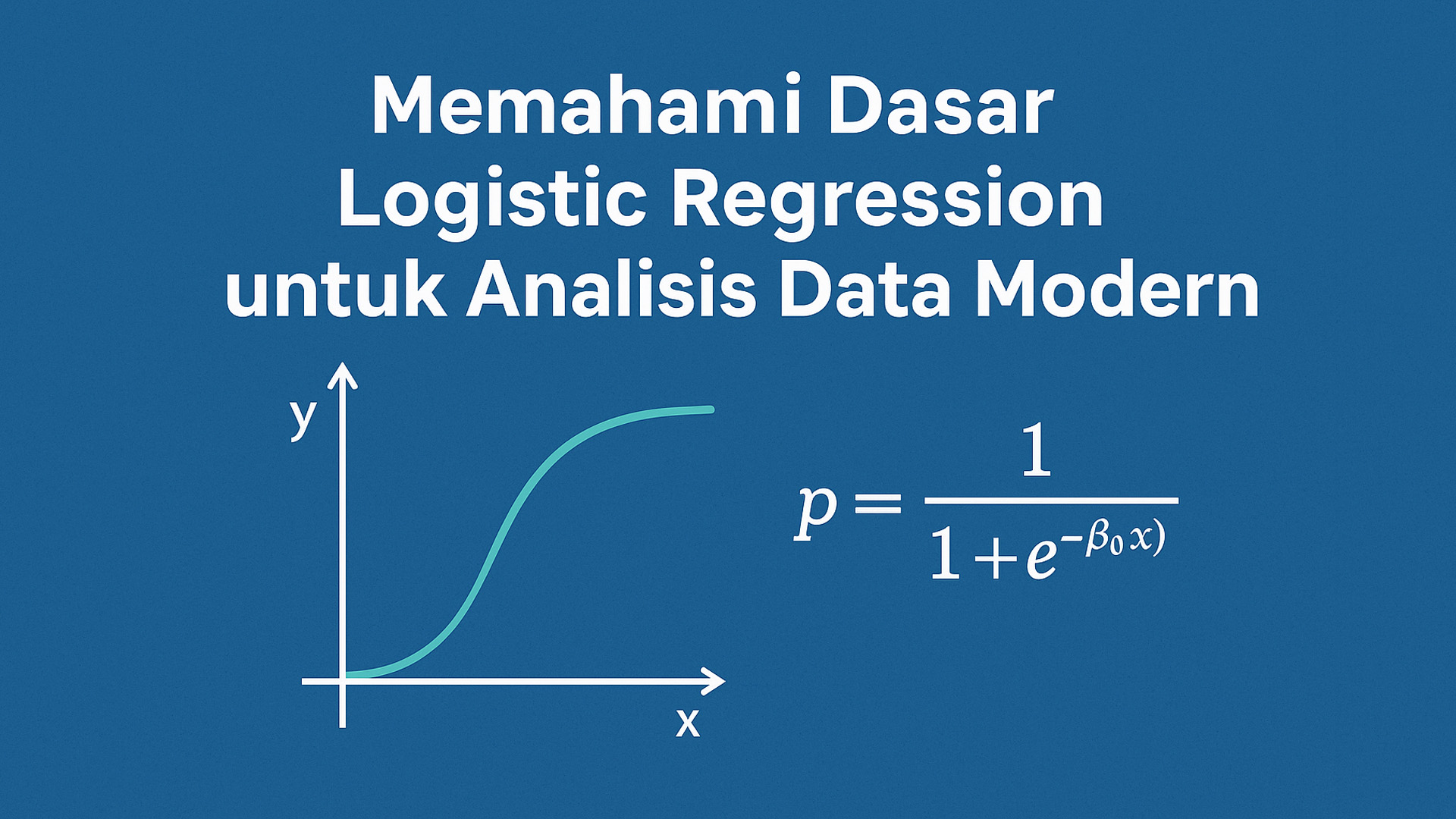
Understanding the Basics of Logistic Regression for Modern Data Analysis
Introduction
In today’s modern data analysis, we often need to predict outcomes that are yes or no, true or false, or simply 1 and 0. For example, predicting whether a customer will cancel a subscription, whether an email is spam, or whether a patient is at risk of a certain disease. For this type of prediction, one of the most popular and simple methods is Logistic Regression.
Although the name suggests it belongs to regression models, logistic regression is mostly used for classification, not for predicting continuous numerical values like linear regression.
What is Logistic Regression?
Logistic Regression is a statistical method used to predict the probability of an event with a binary outcome. In other words, the result has only two possibilities, such as:
-
1 or 0
-
Positive or negative
-
Yes or no
The model works by applying a logistic or sigmoid function, which transforms any input value—no matter how large or small—into a range between 0 and 1. This result can then be interpreted as a probability.
Example:
If a logistic regression model predicts a probability of 0.8 (80%) that someone will buy a product, we can interpret that the person is very likely to make the purchase.
Why is Logistic Regression Important?
-
Simple yet powerful – Easy to understand and implement, but effective in many real-world cases.
-
Interpretable – Provides probabilities that are straightforward to interpret.
-
Widely used – Remains relevant in health, finance, marketing, and technology.
Example Applications
-
Healthcare: predicting whether a patient is at high risk of diabetes based on age, weight, and lifestyle.
-
Marketing: predicting whether a customer will open a promotional email.
-
Finance: evaluating whether a loan applicant is likely to default.
Limitations of Logistic Regression
Even though logistic regression is useful, it has its limits:
-
Not suitable for highly complex data with many interactions.
-
Requires an assumption of linearity between input variables and the log-odds.
-
Less effective than advanced models such as Random Forests or Neural Networks when dealing with large and complex datasets.
Conclusion
Logistic Regression is an excellent starting point for anyone interested in modern data analysis. With its simple yet practical concept, this method often serves as the "gateway" before moving on to more advanced machine learning algorithms.