The Rise of Agentic AI: A Revolution Bigger than ChatGPT
1. Introduction: Why Agentic AI Matters in Modern Tech
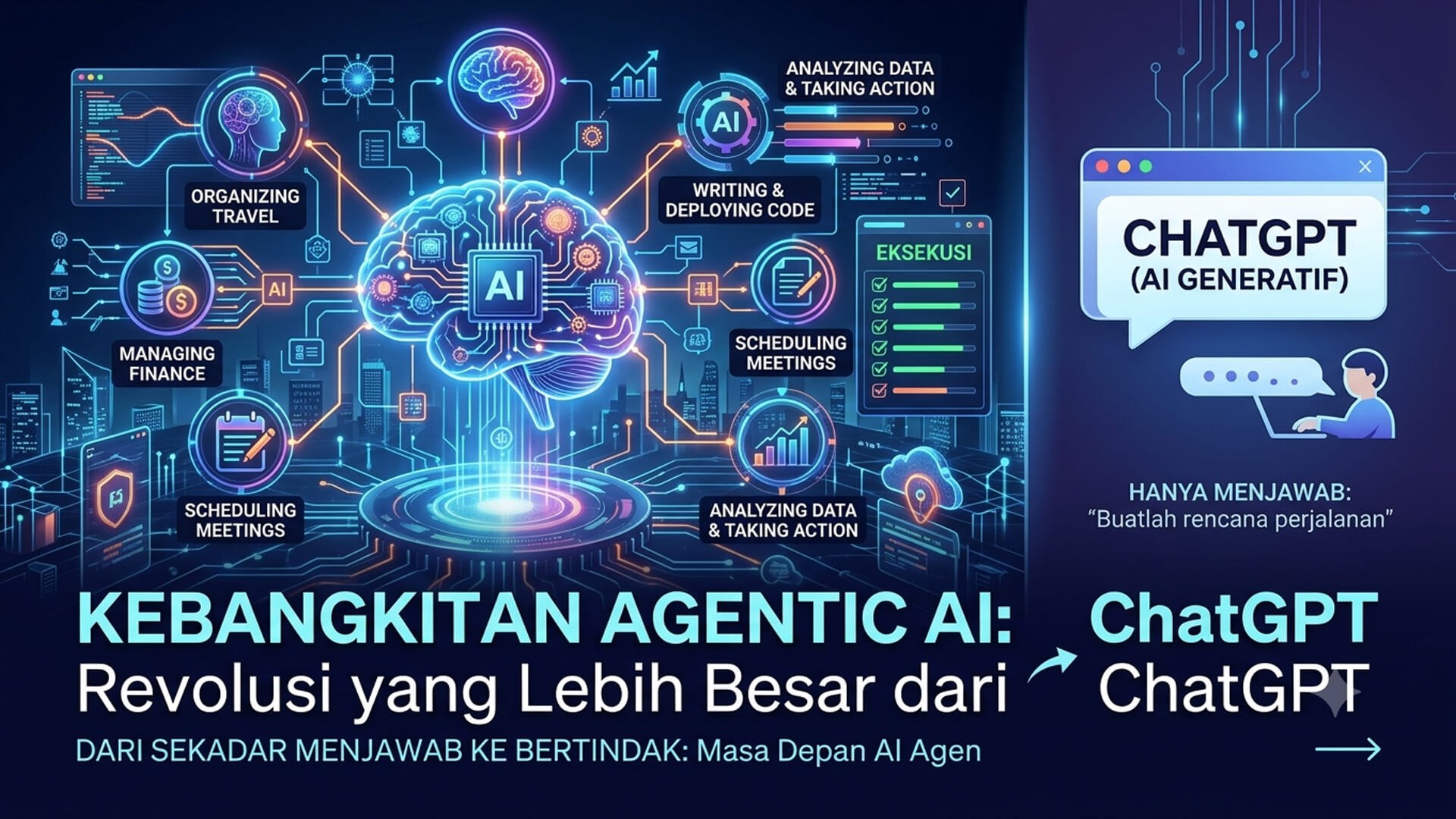
In recent years, the technology world has been reshaped by the advent of generative artificial intelligence, primarily driven by the launch of ChatGPT. This technology transformed how humans interact with machines, write code, create content, and search for information. However, conventional Large Language Model (LLM) systems still possess a fundamental limitation: they are reactive. Users must provide specific prompts to obtain a response, and the system cannot take subsequent actions independently. This is where Agentic AI emerges as a powerful new paradigm. This type of artificial intelligence does not merely process text, but acts as an autonomous agent capable of planning, making decisions, and executing tasks with minimal human intervention. The transition from standard generative AI to Agentic AI is predicted to be a much larger revolution, bringing us one step closer to full automation across various industrial sectors.
2. Definition: What Is Agentic AI?
Agentic AI refers to artificial intelligence systems designed with autonomy, goal-orientation, and the ability to act independently within a given environment. Unlike standard language models that only predict the next word in a sentence, Agentic AI utilizes the model as a reasoning engine to solve problems. These systems are equipped with short-term and long-term memory capabilities, planning mechanisms to map out problem-solving steps, and access to external tools such as APIs, databases, and search engines. With these components, Agentic AI can receive a complex end goal from a user, break it down into smaller tasks, execute those tasks sequentially, evaluate its own results, and make adjustments if errors occur along the way.
3. Key Functions of Agentic AI
To fully comprehend the power of this technology, here are at least four key functions that Agentic AI possesses:
- Self-Planning and Reasoning: The ability to accept high-level instructions and independently break them down into logical workflows without step-by-step guidance from the user.
- Tool Integration: The capacity to recognize when to use specific tools, such as running SQL queries to retrieve data, using a calculator for complex computations, or calling third-party APIs to send emails.
- Self-Reflection and Error Correction: The ability to evaluate its own output, detect mistakes or functional failures, and repeat the process using alternative strategies to achieve the set objective.
- Multi-Agent Collaboration: The capability for multiple specialized agents to work together, exchange information, and divide tasks to complete large-scale projects efficiently.
4. Implementation Steps for Agentic AI
Developing and deploying Agentic AI within business workflows requires a systematic approach to ensure security and efficiency. The implementation steps are as follows:
- Define Objectives and Scope: Clearly define the problem the agent needs to solve and the boundaries of the environment in which the agent will operate.
- Select Base LLM: Choose a powerful large language model as the reasoning core of the agent, preferably a high-tier model with strong logical reasoning capabilities.
- Equip Tools: Connect the agent to necessary APIs, databases, or execution scripts required to complete their tasks, and provide secure access credentials.
- Design Prompts and Workflows: Create system prompts that define the agent's role, behavioral constraints, and planning methods such as ReAct (Reasoning and Acting) or Plan-and-Solve.
- Sandbox Testing: Run the agent in a secure simulated environment to observe its behavior, ensure no harmful commands are executed, and evaluate success rates.
- Deployment and Monitoring: Deploy the agent to production systems with human-in-the-loop oversight for sensitive tasks, and regularly monitor its performance and costs.
5. Advantages of Agentic AI
The adoption of Agentic AI provides numerous strategic advantages compared to traditional artificial intelligence systems:
- Enhanced Operational Efficiency: Reduces the need for human intervention in routine tasks that require data analysis and mid-level decision-making.
- High Scalability: Capable of handling thousands of complex tasks in parallel without fatigue, significantly increasing organizational productivity.
- Accurate Data-Driven Decision Making: Minimizes human error by objectively analyzing information from multiple data sources before taking action.
- Outstanding Adaptability: Can adapt to changing situations or system failures in real-time through continuous self-evaluation processes.
6. Conclusion
Agentic AI is not just a continuation of the chatbot trend, but a paradigm shift toward true intelligent automation. With the ability to plan, utilize tools, learn from mistakes, and operate independently, this technology will redefine how industries operate in the future. Understanding and starting to adopt this technology early is a crucial step for organizations aiming to remain relevant and competitive in this rapidly evolving era of digital transformation.