API Design Best Practices with REST and GraphQL: A Modern, Scalable, and Maintainable Guide
The Critical Role of API Design in Modern Tech Ecosystems
In today's landscape of microservices and cloud-native architectures, Application Programming Interfaces (APIs) serve as the vital connective tissue of software systems. They facilitate efficient communication between diverse applications, platforms, and devices. Poorly designed APIs can lead to performance bottlenecks, high maintenance costs, and operational friction. Consequently, mastering and implementing API design best practices using REST (Representational State Transfer) and GraphQL has become a foundational requirement for modern software architects and developers.
Choosing between REST and GraphQL is not about finding a single solution; it is about understanding the unique needs of your application. REST offers simplicity, standardization, and leverages existing HTTP infrastructure, whereas GraphQL provides high flexibility by allowing clients to request exactly the data they need. By applying structured design principles, both paradigms can be utilized to build systems that are highly scalable under heavy workloads and straightforward to maintain as business requirements evolve.
Defining Modern API Design: REST vs GraphQL
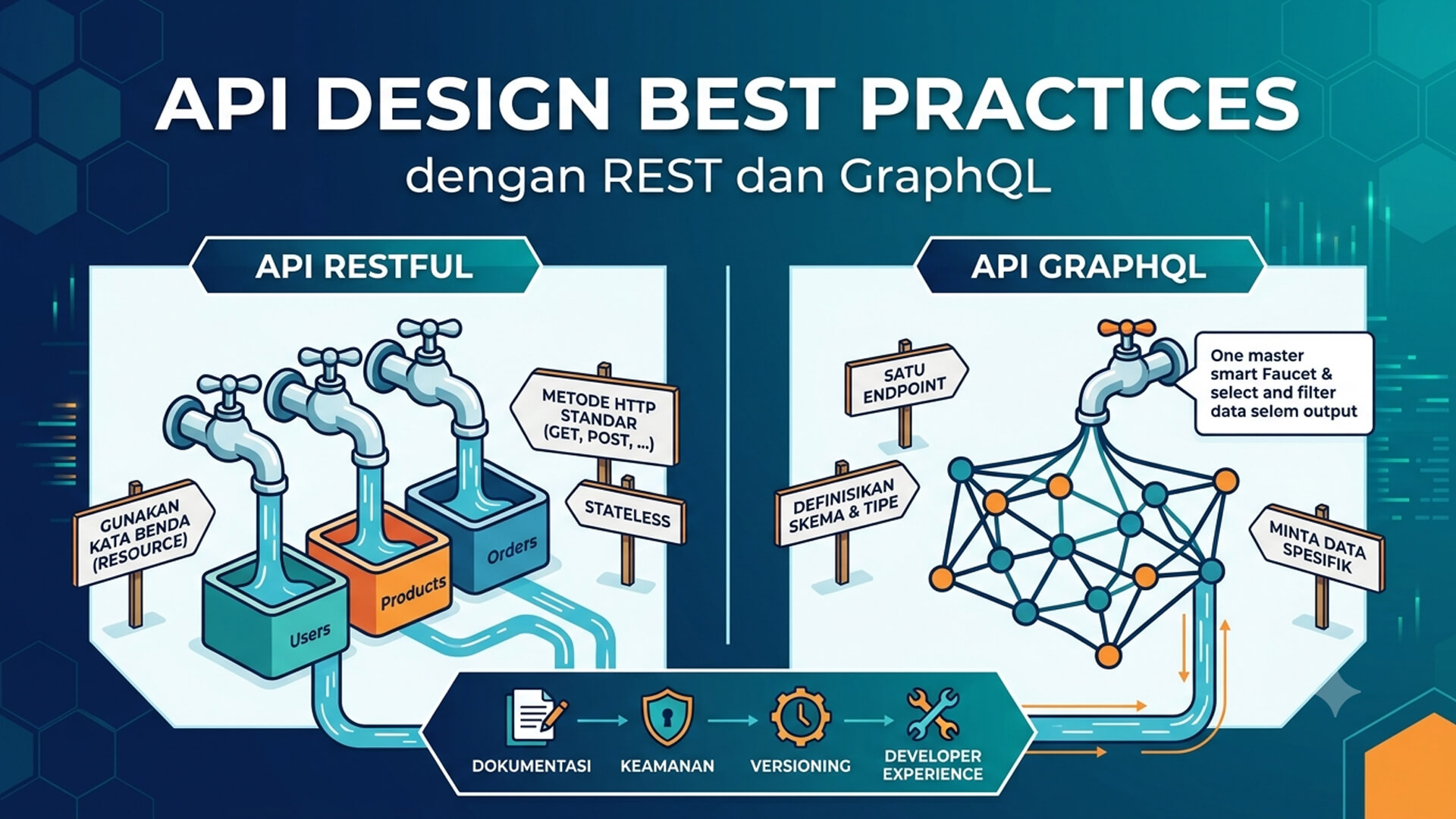
REST (Representational State Transfer) is an architectural style introduced by Roy Fielding in 2000. It relies on a stateless, client-server communication model where resources are identified by unique Uniform Resource Identifiers (URIs). REST leverages standard HTTP methods such as GET, POST, PUT, and DELETE to perform operations on these resources, ensuring that communication remains uniform, predictable, and easy to cache across the network.
GraphQL is a query language for APIs and a runtime for fulfilling those queries with your existing data. Developed internally by Facebook in 2012 and open-sourced in 2015, GraphQL provides a complete description of the data in your API. Unlike REST, which exposes multiple endpoints for different resources, GraphQL typically exposes a single endpoint (commonly POST /graphql). It empowers clients to request specific data structures, and the server returns a matching JSON response, eliminating the common issues of over-fetching and under-fetching data.
Key Functions of a Well-Designed API
- Standardization of Data Exchange: A well-designed API establishes a clear, predictable contract between the service provider and consumers, reducing integration complexity and accelerating third-party development.
- Decoupling and Separation of Concerns: By cleanly separating backend business logic from frontend presentation layers, development teams can work independently and deploy features without blocking one another.
- Optimized Data Payload and Transfer: An efficient API design minimizes the volume of data transmitted over the network, reducing latency and lowering bandwidth consumption for end-users.
- Centralized Security and Access Control: The API acts as the primary security gateway, protecting internal systems and databases through standard authentication, authorization, rate limiting, and data encryption.
Step-by-Step Implementation for Scalable and Maintainable APIs
Building an API that remains reliable over time requires a systematic approach to design, security, and documentation. Follow these essential implementation steps:
- Data Modeling and Architectural Planning: Identify core business entities and their relationships. Determine whether your application is better suited for a resource-oriented model (REST) or a graph-oriented model (GraphQL) based on the complexity of data relationships.
- Schema and Route Design: For REST APIs, use plural nouns for URI paths (e.g.,
/api/v1/users) and adhere to standard HTTP status codes. For GraphQL, design a strong Schema Definition Language (SDL) defining clear types, queries, mutations, and subscriptions. - Establishing API Evolution Strategies: Implement consistent versioning for REST (such as URL path versioning or custom headers). For GraphQL, avoid breaking changes by leveraging the
@deprecateddirective to phase out old fields while gradually introducing new ones. - Integrating Security and Input Validation: Enforce secure token-based authentication (such as JWT or OAuth2) over HTTPS. Validate and sanitize all incoming payloads on the server side to prevent security vulnerabilities such as injection attacks.
- Performance Optimization and Error Handling: Implement caching strategies, such as HTTP caching for REST or persisted queries for GraphQL. Define a consistent, structured error format to assist client-side developers in troubleshooting issues efficiently.
- Automating Documentation: Utilize tools like OpenAPI/Swagger to generate interactive, up-to-date documentation for REST APIs. For GraphQL, take advantage of built-in schema introspection to provide interactive documentation via GraphiQL or GraphQL Playground.
Advantages of Adhering to API Design Best Practices
- High System Scalability: Clean decoupling of services allows individual components to be scaled independently, making it easier to handle traffic spikes in cloud-native environments.
- Accelerated Developer Velocity: Clear API contracts and documentation reduce the need for constant cross-team coordination, allowing teams to deliver features autonomously.
- Superior User Experience (UX): Efficient data transfer translates to faster loading times, responsive interfaces, and reduced mobile data consumption for end-users.
- Simplified Long-Term Maintenance: Standardized structures, predictable error handling, and documentation reduce technical debt, making it easier to refactor code or onboard new developers.
Conclusion
Designing modern, scalable, and maintainable APIs requires a commitment to planning and adherence to established industry standards. Whether you choose the stable, resource-centric approach of REST or the flexible, query-centric capabilities of GraphQL, the primary goal remains to deliver a secure, efficient, and intuitive developer experience. By adopting these best practices, engineering teams can build a stable digital foundation capable of supporting sustainable business growth.