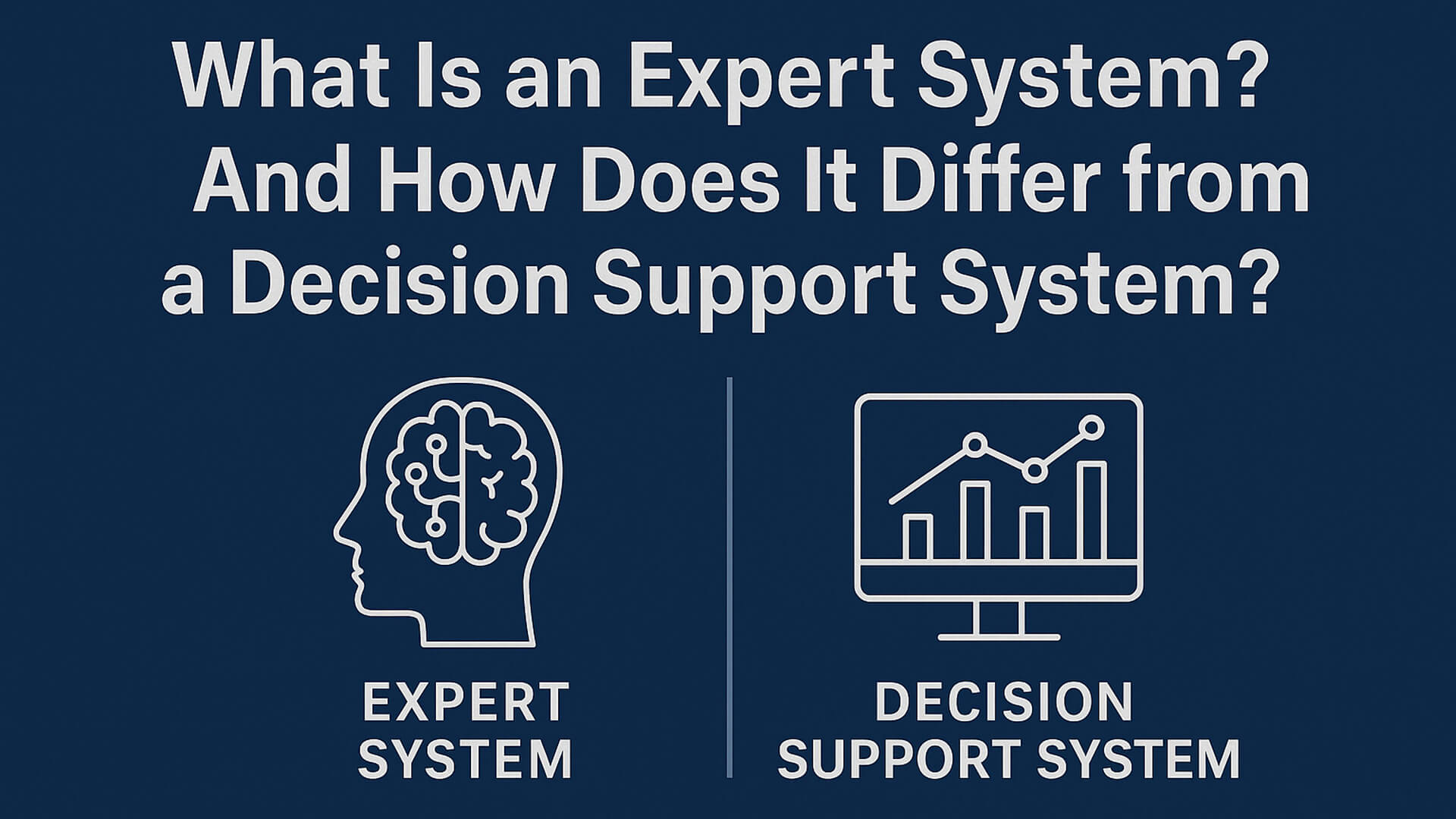
What Is an Expert System? And How Does It Differ from a Decision Support System?
In the field of information technology, terms like expert system and decision support system (DSS) are often mentioned. Both are computer-based systems designed to assist in problem-solving, but they differ in approach and function. This article provides a clear overview of what an expert system is and how it differs from a decision support system.
What Is an Expert System?
An Expert System is a computer-based system designed to simulate the decision-making ability of a human expert. It works by utilizing a knowledge base and an inference engine to draw conclusions based on a set of facts or inputs provided by the user.
The main goal of an expert system is to replace or assist the role of a human expert in a specific domain, such as medicine, agriculture, or engineering.
Characteristics of Expert Systems:
-
Built on a knowledge base containing expert-level knowledge.
-
Uses logical rules (IF-THEN) to make decisions.
-
Provides explanations for its conclusions or recommendations.
-
Can handle uncertainty using probability, fuzzy logic, or other techniques.
What Is a Decision Support System (DSS)?
A Decision Support System is an information system designed to support the decision-making process by providing data analysis, modeling, and scenario exploration tools. A DSS does not make decisions for the user but offers analytical support to improve the decision-making process.
DSS is typically used by managers or decision-makers in an organization to evaluate different alternatives before making a choice.
Characteristics of Decision Support Systems:
-
Based on historical data and analytical models.
-
Offers an interactive environment for users to explore scenarios.
-
Supports semi-structured or unstructured decision-making.
-
Provides recommendations or analysis, not definitive answers.
Key Differences Between Expert Systems and Decision Support Systems
| Aspect | Expert System | Decision Support System |
|---|---|---|
| Purpose | Mimics expert reasoning | Supports human decision-making |
| Knowledge Base | Rules and expert experience | Data, models, and analytics |
| Type of Decision | Provides specific solutions | Offers alternatives and analysis |
| Approach | Based on Artificial Intelligence | Based on data analysis and modeling |
| Main Users | Non-expert users seeking expert advice | Managers or decision-makers in organizations |
Conclusion
Both expert systems and decision support systems play a crucial role in helping users solve problems effectively. The main difference lies in their approach: expert systems replicate expert-level knowledge, while decision support systems offer analytical tools to guide decision-makers toward better outcomes.
Understanding these differences helps organizations choose the right system depending on their specific needs or the nature of the problems they face.