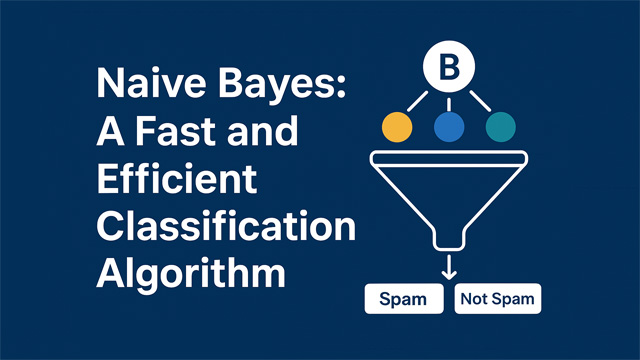
What is Naive Bayes Method?

In the world of machine learning, one of the most commonly used algorithms for data classification is Naive Bayes. This method is very popular because of its simplicity, efficiency in handling large datasets, and its ability to provide reasonably accurate results despite relying on relatively simple assumptions.
What is Naive Bayes?
Naive Bayes is a machine learning algorithm based on Bayes' theorem with a strong assumption of independence among the features in the dataset. Although this assumption of independence rarely holds in real-world scenarios, the method still delivers excellent results in various classification tasks, particularly in text data, such as sentiment analysis or spam email detection.
Bayes' Theorem
Naive Bayes is based on Bayes' Theorem, which connects the probability of an event based on the evidence at hand. Here is the basic formula for Bayes' theorem:
Where:
-
P(A|B) is the probability that hypothesis A is true given evidence B.
-
P(B|A) is the probability that evidence B occurs given hypothesis A.
-
P(A) is the prior probability of hypothesis A.
-
P(B) is the prior probability of evidence B.
In the context of Naive Bayes, hypothesis AAA represents the class of the data (e.g., spam or not spam), and evidence BBB represents the features (such as words in an email).
Naive Bayes Assumptions
The naive or simple assumption in Naive Bayes is that each feature is independent of the others, meaning that the value of one feature does not affect the value of any other feature. For example, in the case of classifying spam emails, Naive Bayes assumes that the presence of the word "free" in an email is not influenced by the presence of the word "offer" in the same email.
Types of Naive Bayes
There are several types of Naive Bayes models that can be used depending on the type of data:
-
Gaussian Naive Bayes: Used when the features in the data are normally distributed or Gaussian.
-
Multinomial Naive Bayes: Suitable for categorical or count data, such as text data represented by word counts (number of times a word appears).
-
Bernoulli Naive Bayes: Used when the features in the dataset are binary (e.g., whether a word appears in an email or not).
Advantages of Naive Bayes
-
Simple and Fast: Naive Bayes is very fast in both training and prediction, even with very large datasets.
-
Efficient for Sparse Data: This method works very well for data with many features but few actual values, such as text analysis.
-
Good Performance for Text Classification: Naive Bayes is often used in text classification problems like spam detection and sentiment analysis.
Disadvantages of Naive Bayes
-
Unrealistic Independence Assumption: The assumption that features are independent of each other rarely holds true in real-life applications, which can affect model accuracy.
-
Performance on Imbalanced Data: If the dataset has a large class imbalance, Naive Bayes may perform less optimally.
Naive Bayes Implementation with Python
Here’s an example of implementing Naive Bayes using Python and the Scikit-learn library:
from sklearn.model_selection import train_test_split
from sklearn.naive_bayes import GaussianNB
from sklearn.metrics import accuracy_score

# Example data
X = [[1, 2], [2, 3], [3, 4], [4, 5]]
y = [0, 0, 1, 1]

# Split data into training and testing sets
X_train, X_test, y_train, y_test = train_test_split(X, y, test_size=0.3)

# Create Naive Bayes model
model = GaussianNB()

# Train the model on the training data
model.fit(X_train, y_train)

# Predict on the testing data
y_pred = model.predict(X_test)

# Calculate accuracy
accuracy = accuracy_score(y_test, y_pred)
print(f"Model accuracy: {accuracy}")
Conclusion
Naive Bayes is a simple yet powerful algorithm for classification tasks, especially in text problems and large datasets. Although there are some assumptions that may not always be accurate, the method remains a popular choice for many practical applications.
By leveraging probability and Bayes' theorem, Naive Bayes can provide fast and efficient predictions, making it a solid choice in many scenarios, especially when speed and scalability are important.