The Fate of Old PHP Frameworks: Yii and CodeIgniter Amid Laravel’s Dominance
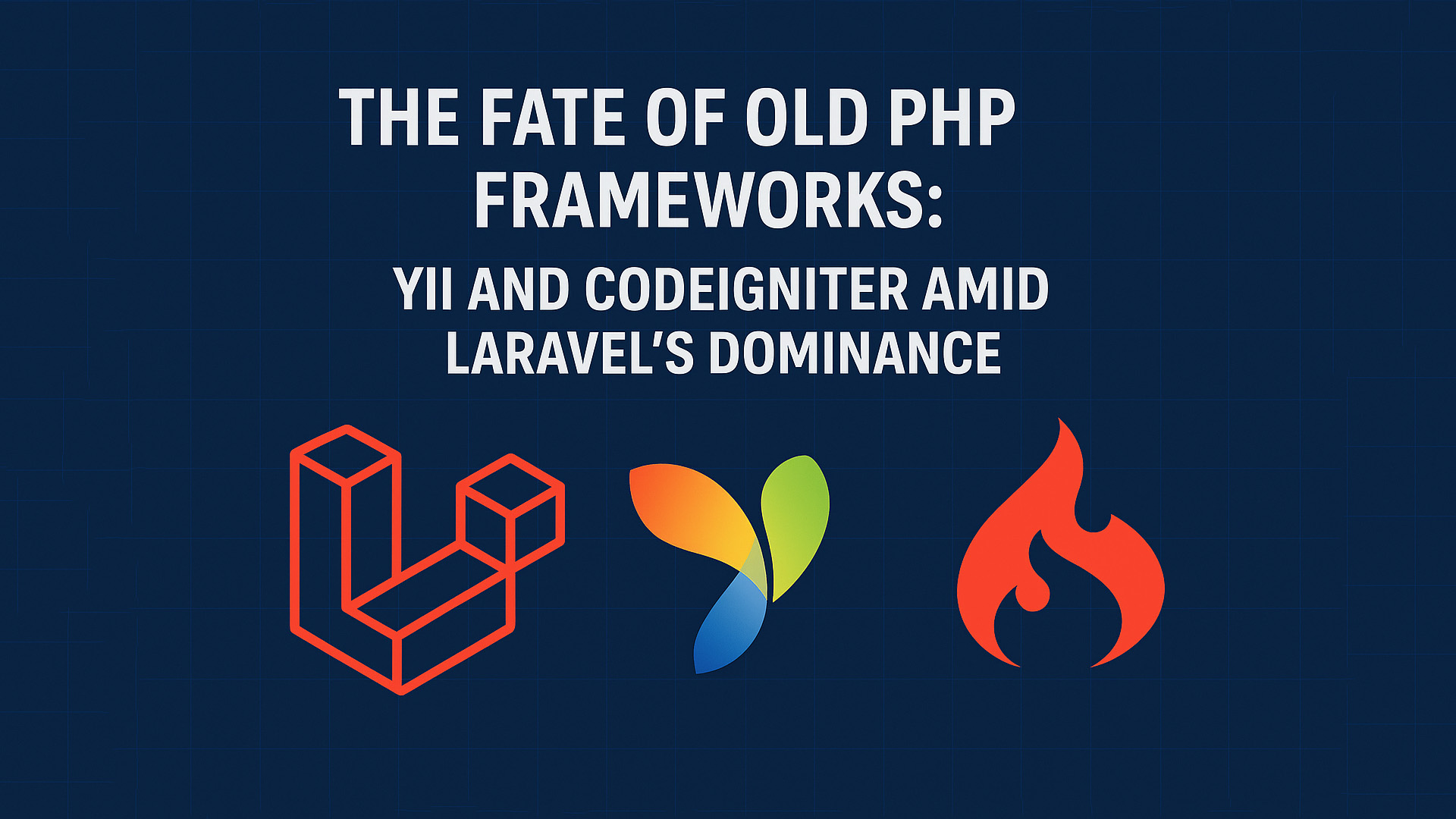
Before Laravel became the most popular PHP framework, the web development world was once ruled by two others: Yii and CodeIgniter.
Both played a crucial role in simplifying PHP development long before Laravel was even created.
Let’s explore their history, evolution, and how they compare to today’s leading framework Laravel.
Origins and History
CodeIgniter
Released in 2006 by EllisLab, CodeIgniter quickly gained popularity for being lightweight, fast, and beginner-friendly.
Back then, many PHP developers struggled with complex setups, and CodeIgniter stood out for its simplicity and excellent documentation.
When EllisLab stopped maintaining it, the British Columbia Institute of Technology (BCIT) took over in 2014 and released CodeIgniter 4, bringing support for modern PHP versions and better architecture.
Yii Framework
Yii, meaning “Yes It Is!”, was released in 2008 by Qiang Xue.
It focused on high performance, scalability, and security, offering more built-in features than CodeIgniter, such as ORM, form validation, caching, and RBAC (Role-Based Access Control).
In 2014, Yii 2 introduced modern PHP standards like namespaces, Composer, and MVC structure. Its latest iteration, Yii 3, brings modularity and improved compatibility with modern systems.
Laravel
Introduced in 2011 by Taylor Otwell, Laravel took inspiration from CodeIgniter but introduced a cleaner, more elegant structure.
It brought features like Eloquent ORM, Blade templating, routing, middleware, and a powerful Artisan CLI.
Laravel’s strength lies not just in its features but in its ecosystem with tools like Forge, Vapor, Nova, and Horizon, plus outstanding documentation and tutorials that make it very beginner-friendly.
Comparison of the Three Frameworks
| Aspect | Laravel | Yii | CodeIgniter |
|---|---|---|---|
| Release Year | 2011 | 2008 | 2006 |
| Philosophy | Modern & Elegant | Secure & Fast | Lightweight & Simple |
| ORM | Eloquent ORM | Active Record | Manual or third-party |
| Routing | Very flexible | Fairly flexible | Basic |
| Security | CSRF, Encryption, XSS | RBAC, CSRF | Basic |
| Community | Very large | Moderate | Shrinking |
| Speed | Medium | High | Very high |
| Strengths | Complete ecosystem, active community | Strong performance and security | Simple and fast |
| Weaknesses | Heavy for small apps | Less trendy now | Lacks modern features |
Their Place in Modern PHP Development
Laravel dominates the current PHP framework landscape, powering thousands of projects globally.
Yii remains relevant for enterprise-level or performance-critical applications. Its strong architecture and stability make it a top choice for long-term systems.
CodeIgniter, though less popular today, is still appreciated by developers who prefer minimal configuration and fast performance ideal for smaller or educational projects.
Conclusion
While Laravel has taken the spotlight, the contributions of Yii and CodeIgniter should never be overlooked.
They paved the way for modern PHP development and influenced how frameworks are structured today.
If you’re starting out, Laravel is the best place to begin but learning about Yii and CodeIgniter gives you valuable insight into PHP’s evolution and how web development has matured over the years.