Microservices vs Monolith: When to Choose Each?
The Criticality of Architectural Choices in Modern Software Engineering
In today's fast-paced digital economy, software architectural decisions represent some of the most critical inflection points in a product's lifecycle. Engineering leaders and system architects are constantly faced with a classic dilemma: whether to build and maintain systems using a cohesive monolithic approach, or to transition towards a distributed microservices architecture. This fundamental choice influences not only how code is written, but also how teams are organized, how quickly new features can be safely deployed to production, and the overall operational costs of the infrastructure. Making the wrong architectural decision early on can result in massive technical debt, stifle innovation, and ultimately lead to catastrophic product failures.
With the rapid rise of cloud computing and DevOps practices, microservices have experienced an explosion in popularity. Many organizations have rushed to decompose their monolithic applications, chasing the promises of extreme scalability and developer autonomy. However, this trend is frequently adopted without a thorough understanding of the massive operational complexity it introduces. Monoliths, often unfairly characterized as outdated, remain an incredibly powerful, efficient, and appropriate pattern for many software development scenarios. Consequently, an objective, balanced understanding of the trade-offs between these two architectures is indispensable for modern technology professionals.
Defining Monolith and Microservices Architectures
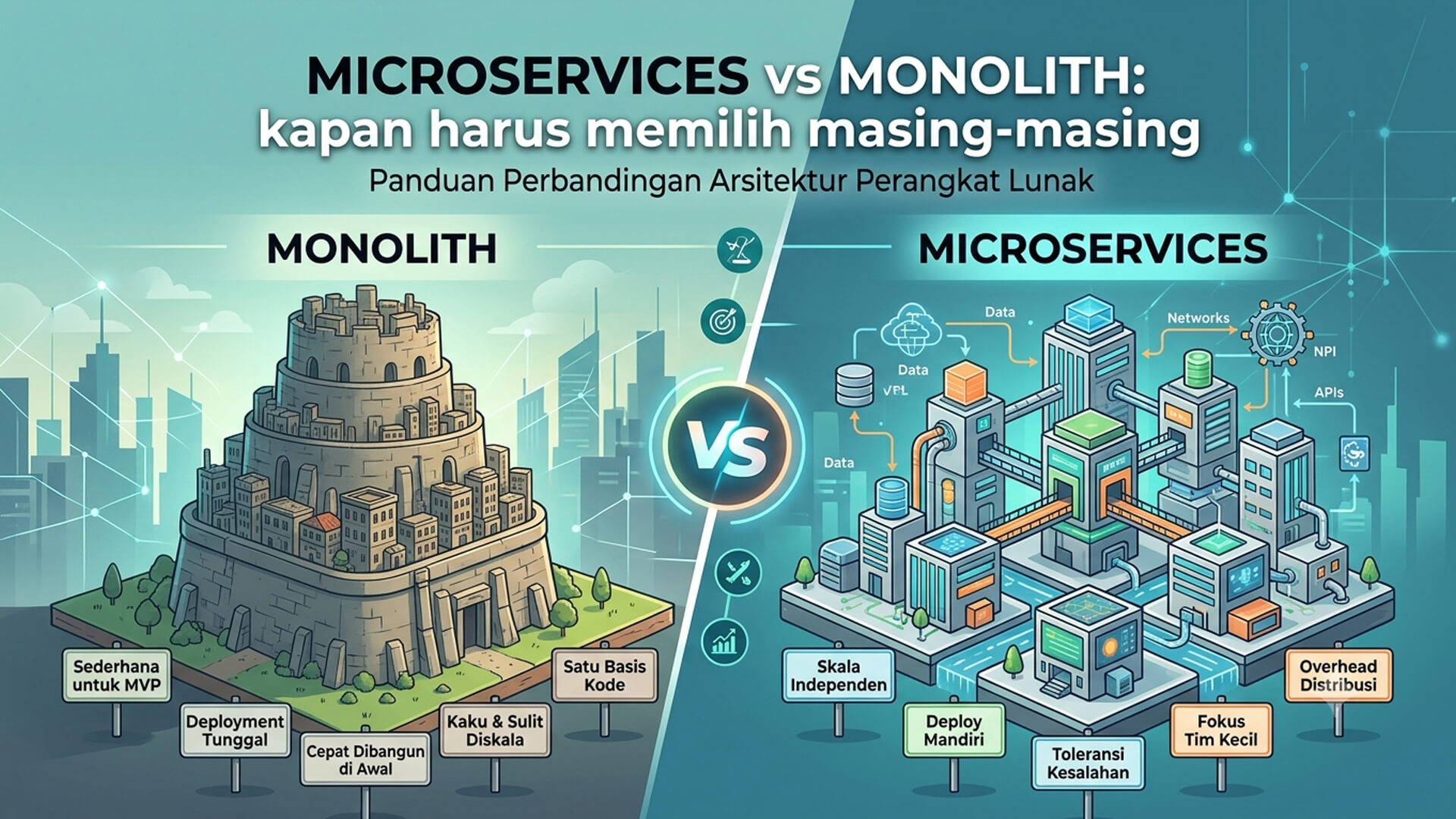
A monolithic architecture is a traditional software development model where all the functional components of an application are bundled together and executed as a single, unified program. Within a monolith, the user interface, backend business logic, and data access layers are written within a single codebase. All of these components are tightly coupled and deployed simultaneously as a single artifact. At runtime, these modules share the same memory space and computing resources, communicating through extremely fast, in-memory function calls rather than over a network.
In contrast, a microservices architecture is an architectural style that structures an application as a collection of small, autonomous, and loosely coupled services. Each microservice is responsible for a single, well-defined business capability (such as payment processing, inventory management, or user authentication) and owns its own dedicated database. These services communicate with one another using lightweight network protocols, such as HTTP REST APIs, gRPC, or asynchronous message brokers like RabbitMQ and Apache Kafka. Because each service is independent, different teams can develop, test, deploy, and scale them autonomously using diverse technology stacks.
Key Operational Functions in Architecture Comparison
To fully grasp the practical differences between these two architectural patterns, we must examine how key operational functions are executed across both systems:
- Modularity and Boundaries: In a monolith, modular boundaries are logical and exist only within the code, making them highly susceptible to architectural decay over time. In microservices, boundaries are physical and strictly enforced by network interfaces, preventing unhealthy code coupling and cross-domain pollution.
- Data Management and Consistency: Monoliths rely on a centralized database, facilitating simple transactional operations with strong ACID (Atomicity, Consistency, Isolation, Durability) guarantees. Microservices employ a database-per-service pattern, requiring complex eventual consistency models and distributed transaction patterns like the Saga Pattern.
- Scalability Mechanisms: Scaling a monolith requires replicating the entire application across multiple servers behind a load balancer, which can be highly inefficient if only a single module is experiencing high load. Microservices enable granular scalability, allowing resource-intensive services to be scaled independently, optimizing cloud infrastructure spend.
- Deployment and Release Cycles: A monolith requires a complete redeployment of the entire application for even the smallest code change, increasing the risk of deployment failures and slowing down release cycles. Microservices facilitate independent deployments, empowering teams to release updates to production multiple times a day without impacting the rest of the ecosystem.
Practical Steps for Architectural Implementation
Choosing and implementing the right architecture demands a systematic, well-planned approach. The following steps outline a practical path forward:
- 1. Assess Organizational and Team Maturity: Before committing to microservices, ensure your engineering organization has sufficient experience with cloud-native infrastructure, containerization (such as Docker and Kubernetes), and advanced CI/CD automation. If your team is small or just starting out, beginning with a well-structured 'modular monolith' is highly recommended.
- 2. Conduct Domain-Driven Design (DDD): If you choose microservices, start by carefully mapping your business domain. Identify and establish clear Bounded Contexts to define the logical boundaries of each service. This step is essential to avoid building a 'distributed monolith', where services remain tightly coupled over the network.
- 3. Establish Supporting Infrastructure First: Set up an API Gateway to serve as the single entry point for client traffic, implement Service Discovery to manage dynamic service locations, and deploy centralized logging alongside distributed tracing tools (like Jaeger or Zipkin) to monitor system performance.
- 4. Adopt an Incremental Migration Strategy (Strangler Fig Pattern): Never attempt to migrate from a monolith to microservices by rewriting the entire system from scratch. Instead, gradually extract monolithic functionalities into new microservices one by one, slowly strangling the old monolithic codebase until it is entirely decommissioned.
Advantages and Core Trade-Offs
Both architectural patterns offer distinct advantages that must be carefully balanced against their inherent complexities:
- Monolith Advantage - Simplicity of Development: Incredibly straightforward to set up, debug, trace execution paths, and perform comprehensive end-to-end testing locally without dealing with complex network distribution.
- Monolith Advantage - Maximum Network Performance: Since all communication occurs in-memory, monolithic systems do not suffer from network latency or transient network failures that commonly plague distributed systems.
- Microservices Advantage - Robust Fault Isolation: If a single service crashes (for instance, due to a memory leak in a recommendation engine), the core application functions, such as checkout and payments, continue to operate unimpeded.
- Microservices Advantage - Technology Stack Freedom: Development teams can choose the most optimal programming language and database for their specific service's needs, such as Python for data science and Go for high-throughput transactional APIs.
- Microservices Advantage - Organizational Scalability: Enables large organizations to structure their engineering department into small, cross-functional, autonomous teams ('Two-Pizza Teams') that own their services end-to-end without blocking each other.
Conclusion
Ultimately, the debate between microservices and monoliths is not about identifying a single, universally superior architecture, but rather about choosing the right tool for your specific goals. A monolith is an exceptionally efficient, fast, and cost-effective choice for new products, early-stage startups, or applications with low-to-medium domain complexity. Conversely, microservices represent a highly valuable architecture once your application reaches massive scale, possesses a highly complex domain, and is developed by dozens of independent teams. Fully understanding these trade-offs ensures that your organization can build a resilient, adaptable, and scalable software system that perfectly aligns with your long-term business trajectory.