Why Tech Companies Are Racing to Build AI Agents
Introduction
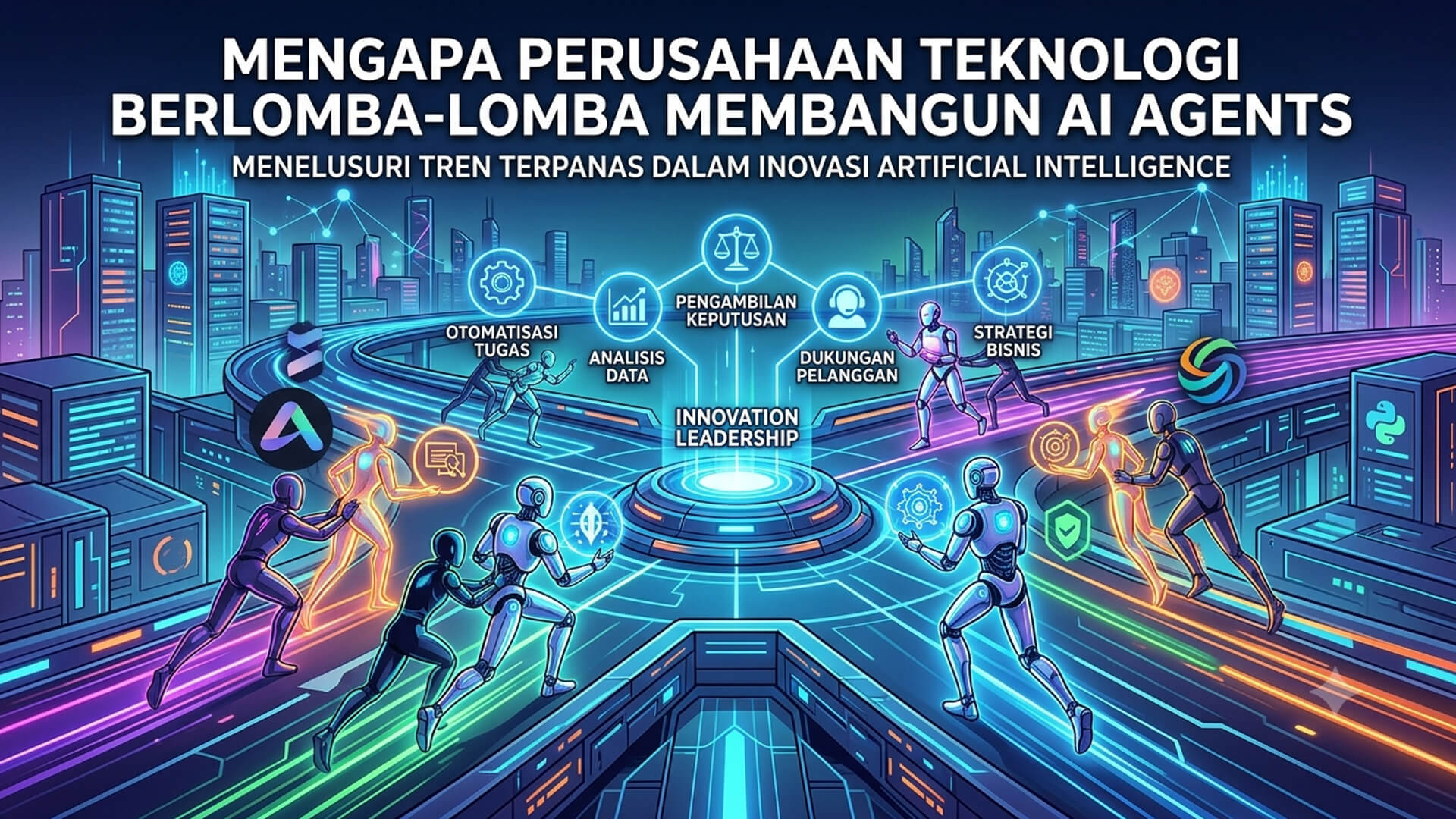
In recent years, the technology industry has witnessed a transition from conventional generative artificial intelligence (AI) models to systems that are interactive and autonomous. While the previous focus was largely on large language models (LLMs) passively responding to user prompts, the industry's spotlight has now shifted toward the development of AI agents. Global tech giants and startups alike are allocating billions of dollars in resources to lead this competition. This phenomenon is an evolutionary leap that will redefine how humans interact with technology and how businesses operate in the digital era.
The demand for operational efficiency and the desire to create personalized products are driving the urgency behind this technology. In a competitive market, companies that adopt and integrate AI agents into their workflows will secure a strategic advantage. Consequently, understanding why this technology has become the new battleground for tech leaders is crucial for industry players and strategic decision-makers.
Definition of AI Agents
At its core, an AI agent is an artificial intelligence-based software system designed to perceive its environment, make autonomous decisions, and take actions to achieve specific goals without requiring constant human intervention. Unlike traditional chatbots that only answer questions based on rigid text patterns or predefined rules, AI agents possess the capacity to plan problem-solving steps logically, utilize various external tools (such as APIs, databases, and calculators), and evaluate their own outputs to make necessary corrections when errors occur.
The key to the effectiveness of AI agents lies in the integration of a large language model as the controlling brain, short-term and long-term memory systems to store interaction context, and the ability to call external functions. This autonomous framework enables AI agents to tackle complex, multi-step tasks, such as managing digital marketing campaigns from conception to performance analysis, or automating entire logistics supply chains.
Key Functions of AI Agents
- Autonomous Planning and Task Decomposition: AI agents can receive high-level instructions and break them down into a logical sequence of smaller tasks. They can draft action plans, prioritize critical steps, and execute them systematically one by one.
- External Tool Integration and Usage: Not limited to their internal training data, AI agents can leverage APIs to search the web, read and write to databases, send emails, and even execute programming code to solve complex computational problems.
- Self-Reflection and Error Correction: AI agents have the ability to analyze the outcomes of their actions. If a step fails or produces invalid data, they can reflect on the failure and try alternative approaches autonomously.
- Contextual Memory Management: By utilizing short-term and long-term memory systems, AI agents can deliver highly personalized, relevant, and consistent actions over extended periods.
Implementation Steps
- 1. Identify Use Cases and Strategic Goals: Clearly define the problem the AI agent is intended to solve by mapping out existing workflows and selecting processes that require high-level automated decision-making.
- 2. Select Architecture and Foundation Models: Choose the right large language model to power the agent, balancing model reasoning capabilities, response speed, computational costs, and data privacy requirements.
- 3. Develop Memory Systems and Tool Integration: Build the necessary memory infrastructure and provide the agent with secure API integrations to access required external tools.
- 4. Implement Reasoning Loops: Integrate reasoning frameworks like ReAct (Reasoning and Acting) to ensure the agent can plan actions, evaluate results, and adapt dynamically to changing situations.
- 5. Systematic Testing and Continuous Optimization: Rigorously test AI agents across various scenarios to ensure the safety, accuracy, and efficiency of their actions before deployment.
Key Advantages of AI Agents
- Scale of Complex Cognitive Automation: Unlike simple rule-based automation, AI agents can handle high variability and unexpected scenarios in cognitive work, freeing up human employees to focus on strategic innovation.
- Radical Reduction in Operational Costs: By delegating administrative duties, data analysis, and advanced customer service tasks to AI agents, companies can significantly reduce operating costs while driving productivity.
- Real-Time Data-Driven Decision Making: AI agents can process massive volumes of data in seconds, extract vital insights, and instantly execute corrective or preventive measures to maintain business continuity.
- Infinite Customer Service Personalization: Equipped with long-term memory and deep contextual understanding, AI agents can provide highly personalized, responsive, and tailored customer support 24 hours a day.
Conclusion
The race to build AI agents is not just about winning a technology competition; it is about building the foundation of the future digital economy. Autonomous AI agents promise a new era of productivity where collaboration between humans and artificial intelligence is harmoniously achieved. The tech companies leading the development of AI agents today are guaranteed to hold the keys to the global industrial landscape of tomorrow.