Why Many Technology Companies Are Migrating to Rust: Performance, Security, and Cost Efficiency
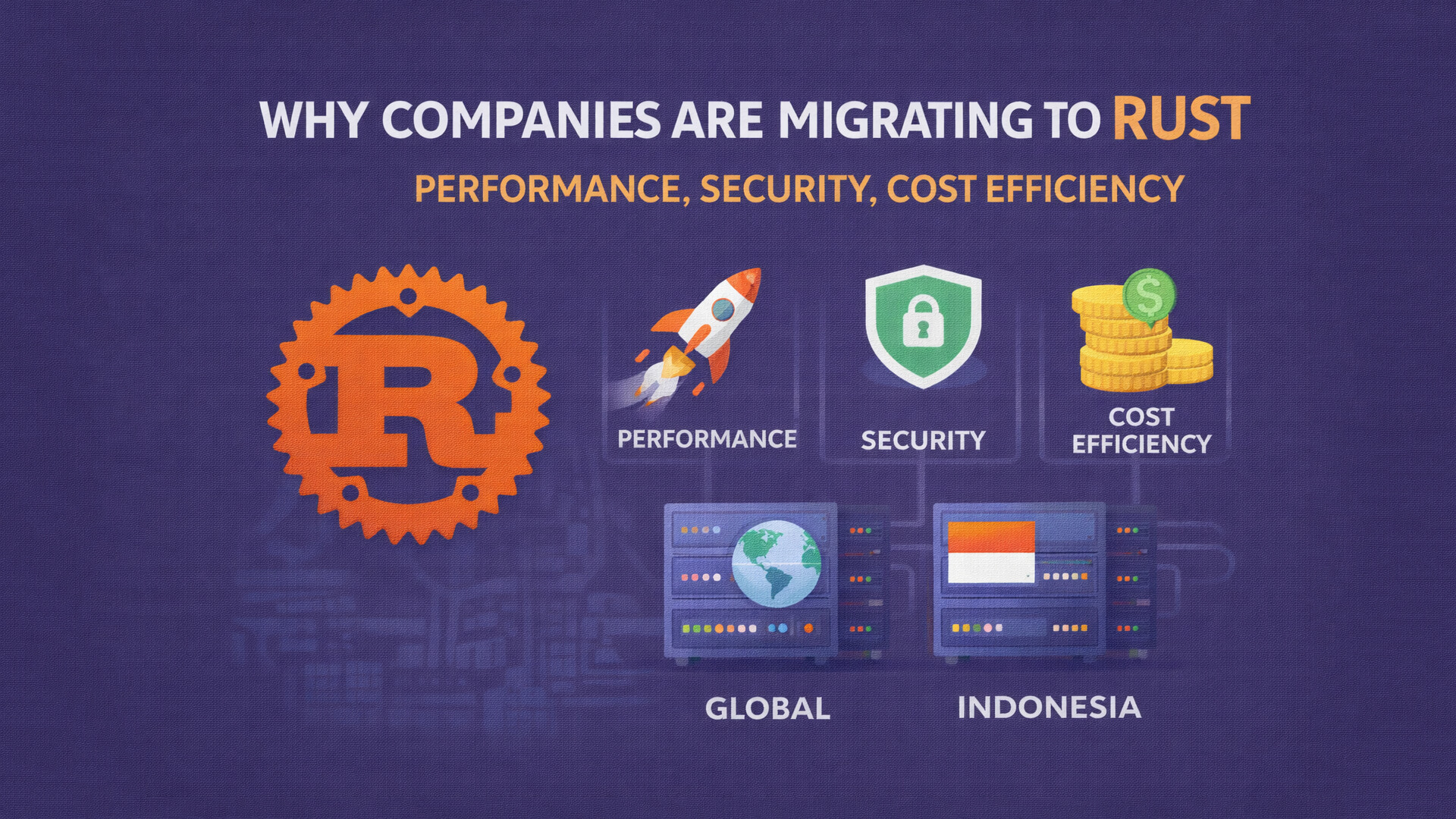
In recent years, Rust has gained strong attention in the technology industry. Many global technology companies, as well as companies in Indonesia, are starting or have already made selective migrations to Rust. This shift is driven by clear benefits in performance, security, and long-term cost efficiency.
This article explains why companies choose Rust, its advantages, and how migration is commonly implemented.
What Is Rust Programming Language?
Rust is a systems programming language designed to build fast, reliable, and secure applications. It focuses on preventing common software issues such as memory errors and system crashes while maintaining high performance.
Rust is often compared to C and C++, but with a stronger emphasis on safety.
Main Reasons Companies Choose Rust
1. High Performance
Rust produces highly optimized machine code, making applications run very fast. This makes it suitable for:
-
High-performance backend services
-
Real-time systems
-
Cloud and networking infrastructure
2. Strong Security
Security is one of Rust’s biggest strengths. Its memory safety system prevents many critical bugs at compile time, reducing vulnerabilities before the application even runs.
This results in:
-
Fewer security issues
-
Lower maintenance costs
-
More stable systems
3. Long-Term Cost Efficiency
Although Rust can be challenging to learn, it helps reduce costs over time by minimizing bugs and system failures. Stable software means:
-
Less emergency fixes
-
Shorter maintenance cycles
-
More productive development teams
Selective Migration Strategy
Most companies do not fully rewrite their systems in Rust. Instead, they use a selective migration approach, which includes:
-
Using Rust for performance-critical modules
-
Replacing sensitive components gradually
-
Keeping existing stable systems intact
This approach reduces risk while still gaining Rust’s benefits.
Rust Adoption Globally and in Indonesia
Globally, Rust is used in:
-
Web browsers and engines
-
Operating systems and networking tools
-
Cloud infrastructure and security services
In Indonesia, Rust adoption is growing in:
-
High-traffic backend services
-
Financial and payment systems
-
Applications requiring high stability
While still growing, the trend shows strong future potential.
Challenges of Using Rust
Rust does have challenges, such as:
-
Steeper learning curve
-
Strict syntax rules
-
Slower initial development phase
However, many companies believe these challenges are worth the long-term benefits.
Conclusion
Companies migrate to Rust because it delivers real improvements in performance, security, and cost efficiency. Through selective migration, organizations can adopt Rust without disrupting existing systems. As technology demands increase, Rust is expected to play a bigger role, including in Indonesia.