Building Productive AI Agents: Frameworks, Tools, and Best Practices
Introduction: The Significance of AI Agents in Modern Tech
The evolution of artificial intelligence has shifted from passive generative models to active autonomous systems, widely known as AI Agents. In the modern tech landscape, organizations no longer seek just large language models (LLMs) that answer queries, but integrated systems capable of planning actions, utilizing external tools, and executing complex tasks independently. Building productive AI agents is key to accelerating operational efficiency, automating intricate cognitive workflows, and bridging the gap between AI reasoning and real-world execution. With a proper understanding of agentic frameworks, tooling, and design methodologies, developers can create robust AI solutions that deliver tangible and lasting business value.
Definition of AI Agents and Core Concepts
Fundamentally, an AI Agent is an artificial intelligence-based software system capable of perceiving its environment, making decisions through reasoning, and executing actions using various tools to achieve specific goals. Unlike traditional chatbots that respond to text inputs linearly, AI Agents possess a dynamic lifecycle. They leverage LLMs as their core 'brains' to analyze situations, decompose large objectives into smaller sub-tasks, and select the most relevant tools—such as databases, web APIs, or code execution environments—to complete their assignments. The core architecture of an AI Agent comprises memory (both short-term and long-term), tools, planning capabilities, and self-reflection loops to evaluate their output quality before presenting it to the user.
Key Functions of AI Agents in a Productive Ecosystem
When deployed in industrial settings and software development pipelines, productive AI agents carry out several essential functions:
- Autonomous Planning (Self-Planning): The capability to break down high-level goals into structured step-by-step pipelines and track progress dynamically without constant human intervention.
- External Tool Integration: The ability to detect when to call third-party APIs, execute SQL queries on database engines, or perform web searches to supplement the model's internal knowledge base.
- Dynamic Memory Management: Retaining short-term interaction context for active sessions and leveraging vector databases for long-term memory to recall user preferences or historical data.
- Multi-Agent Collaboration: Enabling multiple specialized agents with distinct roles—such as a researcher, a writer, and an editor—to communicate, exchange data, and complete complex projects collaboratively.
Implementation Steps to Build an AI Agent
Constructing a productive AI Agent requires a systematic engineering approach from initial design to production deployment. Here are the recommended implementation steps:
- Define Objectives and Boundary Limits: Clearly identify the specific problems the agent is intended to solve. Establish boundary limits to prevent the agent from wandering into overly broad or poorly defined tasks.
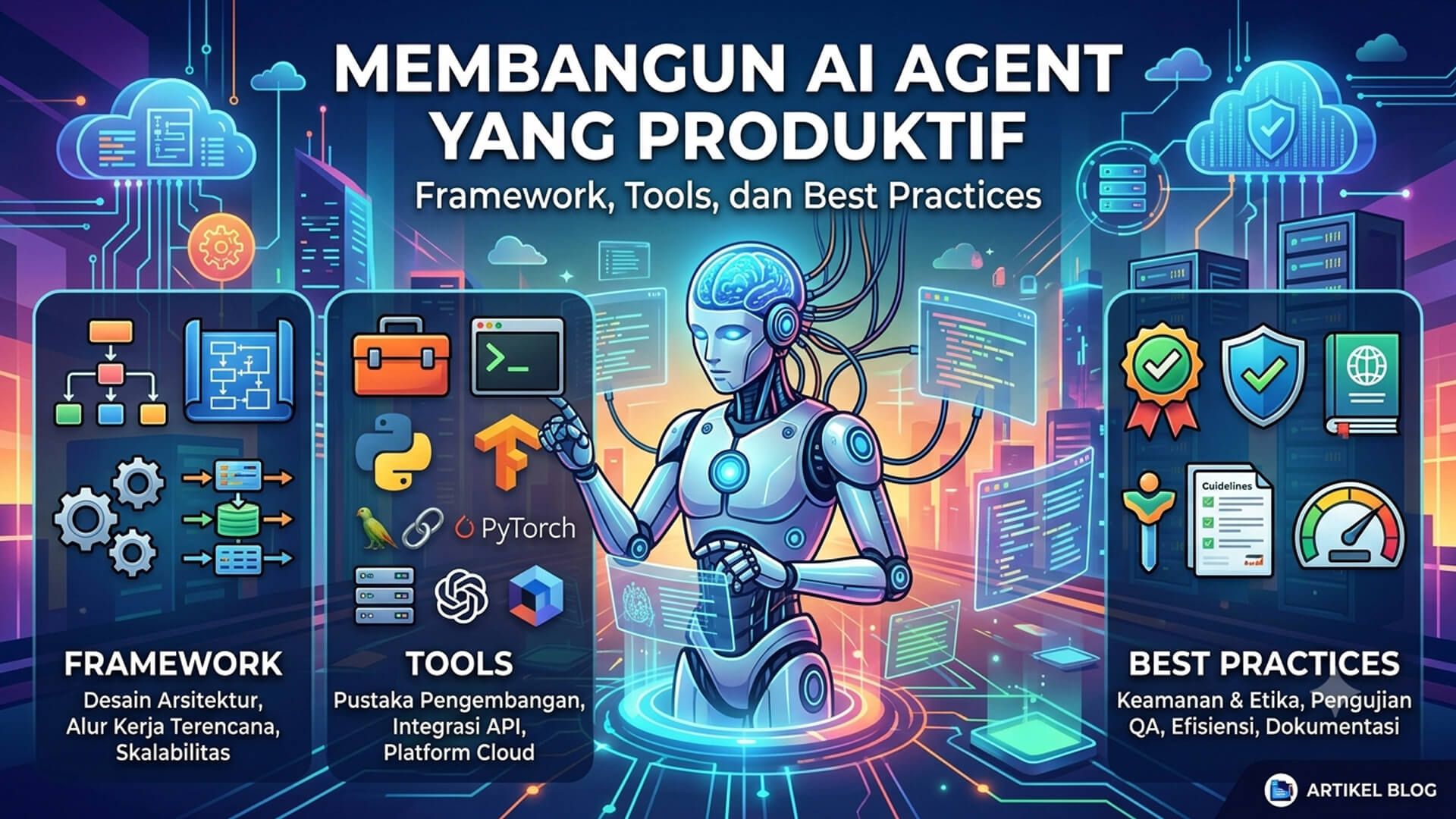
- Select the Right Framework: Utilize mature agentic frameworks such as LangChain, LangGraph, CrewAI, or AutoGen. These frameworks provide crucial abstractions for managing memory, agent loops, and LLM connections.
- Design and Register Tools: Define the external capabilities accessible to the agent. Write highly descriptive function metadata, as the LLM relies on these descriptions to decide when and how to invoke each tool.
- Implement Reasoning and Planning Loops: Set up reasoning patterns like ReAct (Reasoning and Acting) or Plan-and-Solve. This ensures that the agent thinks before acting and critically evaluates the outcome of each action before proceeding.
- Test, Evaluate, and Monitor: Conduct continuous evaluation using representative test datasets. Track token consumption, response latency, and task completion success rates to iteratively refine prompts and logic flows.
Advantages of Deploying AI Agents in Workflows
Deploying well-designed AI Agents offers several significant benefits to organizations and engineering teams:
- Unprecedented Scalability: Agents can operate in parallel around the clock, completing administrative tasks and advanced data analysis in a fraction of the time required by manual processes.
- Data-Driven Decision Accuracy: By accessing real-time data through search tools and internal databases, agents minimize information hallucinations and produce highly accurate outcomes.
- Architectural Flexibility: Developers can easily plug in new tools or expand agent roles as business requirements evolve, without needing to redesign the core system architecture.
- Operational Cost Optimization: Automating repetitive, high-cognitive-load workflows reduces overhead, allowing human resources to focus on high-value strategic and creative initiatives.
Conclusion
Building a productive AI Agent involves far more than simply connecting an LLM to the internet; it requires engineering a cohesive system that blends intelligent planning, robust memory, targeted tools, and a reliable framework architecture. By adhering to best practices—such as defining clear agent boundaries, providing precise tool descriptions, and implementing continuous evaluation loops—developers can build dependable and secure autonomous assistants. The future of human-AI collaboration relies on our capacity to design agents that do not just talk, but effectively act to solve real-world challenges.