Machine Learning with Python: A Guide for Beginners
Introduction: Why Machine Learning Matters in Modern Technology
In today's digital era, data has become one of the most valuable assets for organizations worldwide. However, raw data alone is not enough to generate value; we need a way to analyze and make decisions from this data automatically. This is where machine learning plays an incredibly crucial role. As a branch of artificial intelligence, machine learning enables computer systems to learn from data and improve their performance over time without being explicitly programmed for each task. From personalized product recommendations on e-commerce platforms to real-time financial transaction fraud detection, machine learning has become the primary driving force behind the modern technological innovations we use every day.
For beginners looking to enter the world of artificial intelligence, the Python programming language and the scikit-learn library offer the most welcoming and effective learning path. Python is renowned for its clean, readable syntax and is backed by an incredibly rich ecosystem of scientific libraries. Meanwhile, scikit-learn is one of the most popular and efficient machine learning libraries, providing a wide range of integrated tools for predictive modeling. By understanding the basics of machine learning using these two tools, you will have a solid foundation to develop smart solutions capable of solving various real-world problems.
Definition of Machine Learning and Scikit-Learn
Simply put, machine learning is a scientific discipline focused on developing algorithms and statistical models that enable computers to perform specific tasks without explicit instructions, relying instead on patterns and inference from data. Unlike traditional programming where developers write explicit rules to produce outputs from inputs, machine learning reverses this process: you feed inputs and expected outputs to the algorithm, and the algorithm learns the hidden rules or patterns that connect them.
On the other hand, scikit-learn is an open-source library for the Python programming language built on top of other popular scientific libraries such as NumPy, SciPy, and Matplotlib. This library is specifically designed to facilitate data mining and data analysis. Scikit-learn provides ready-to-use implementations of various machine learning algorithms, ranging from classification, regression, clustering, to dimensionality reduction. With a consistent application programming interface (API) and exceptionally comprehensive documentation, scikit-learn has become an industry standard for both academic and small-to-medium commercial needs.
Key Functions and Features in Machine Learning
In the process of developing a machine learning model, there are several key functions and features that beginners must understand. Here are four primary functions provided by scikit-learn:
- Classification: This function is used to identify the category or label of new data based on training data learned previously. Examples of its application include detecting whether an email is spam or not spam, or classifying medical images as benign or malignant tumors.
- Regression: Unlike classification which predicts discrete labels, regression is used to predict continuous or numerical values. Example applications include estimating house prices based on land area and location, or projecting product sales trends for the next quarter.
- Clustering: This is an unsupervised learning technique used to group similar data points into specific clusters without initial labels. This technique is highly useful for customer segmentation in marketing strategies or grouping documents by topic.
- Data Preprocessing: Before data can be fed into a machine learning algorithm, it often requires cleaning and transformation. Preprocessing functions in scikit-learn include feature scaling, normalization, handling missing values, and encoding categorical variables into a numerical format that the model can understand.
Implementation Steps for Machine Learning
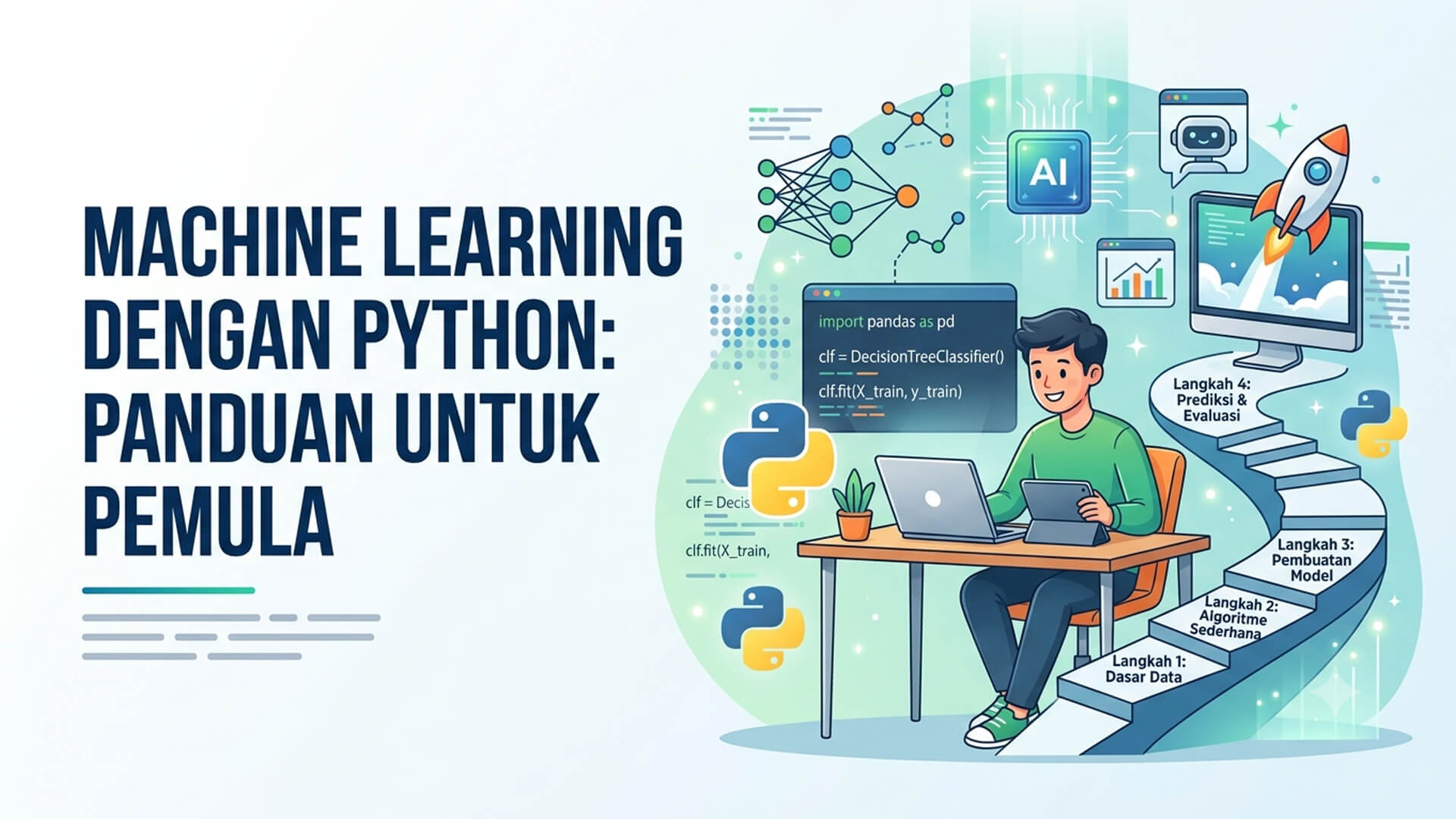
Building your first machine learning project involves a structured workflow to ensure that the resulting model achieves good accuracy and performance. Here are the practical implementation steps using Python and scikit-learn:
- 1. Collect and Prepare Data: The first step is to import the data into your Python environment, usually using a library like pandas. The data must be cleaned of empty values or inconsistencies that could disrupt the machine learning process.
- 2. Split the Data (Data Splitting): Separate your dataset into two main parts: a training set and a testing set. Scikit-learn provides the train_test_split function to split the data randomly. The training data is used to train the model, while the testing data is used to evaluate the model's performance on unseen data.
- 3. Select and Train the Model: Determine the algorithm appropriate for your problem (e.g., Decision Tree or Linear Regression). Initialize the model and use the fit() method to start the training process using the prepared training data.
- 4. Make Predictions and Evaluate: Once the model is trained, use the predict() method on the testing data to obtain prediction results. Evaluate your model's performance using relevant evaluation metrics provided by scikit-learn, such as accuracy for classification or Mean Squared Error (MSE) for regression.
Advantages of Using Python and Scikit-Learn
Choosing the right technology combination is highly decisive for the success of your artificial intelligence project. Here are some of the main advantages of using Python and scikit-learn for machine learning:
- Ease of Use and Simple Syntax: Python is designed with a focus on code readability, allowing beginners to focus on the concepts of machine learning itself rather than getting bogged down in the syntax complexities of a programming language.
- Extensive Ecosystem: Python is supported by an active global community and an outstanding ecosystem of supporting libraries, such as pandas for data manipulation, NumPy for numerical computation, and Matplotlib or Seaborn for data visualization.
- Consistency of the scikit-learn API: All algorithms in scikit-learn follow a consistent design pattern (using the fit, predict, and transform methods), making it easy for developers to switch or compare different algorithms with minimal code changes.
- Abundant Documentation and Community: Scikit-learn features highly detailed official documentation accompanied by interactive code examples. The large community also ensures that almost any issue you encounter has likely already been solved on public forums like Stack Overflow.
Conclusion
Starting a journey in the field of machine learning does not have to be intimidating for beginners. By leveraging the power of the intuitive Python programming language and the comprehensive features of the scikit-learn library, anyone can start building reliable predictive models in no time. From data cleaning to model evaluation, these tools simplify the workflow of artificial intelligence development without sacrificing flexibility and performance. By continuously practicing with various public datasets, you will soon master a skill set that is highly sought after in today's modern technology industry.