From Prompt to Autonomous Agent: The Evolution of AI in the Last 3 Years
Introduction: A New Chapter in the Artificial Intelligence Revolution
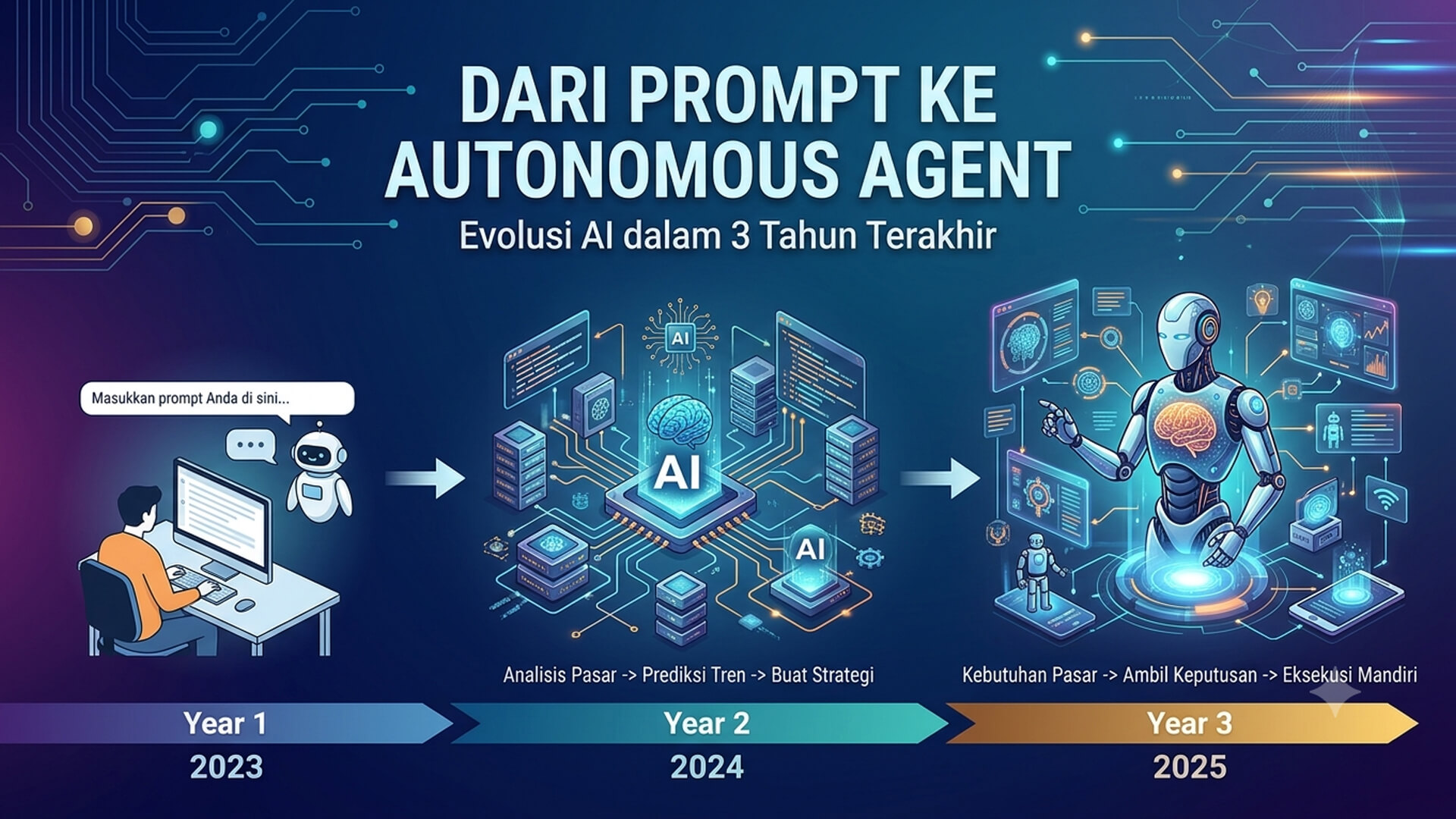
Over the last three years, the landscape of artificial intelligence (AI) has undergone an extraordinary paradigm shift. We have transitioned from an era where humans had to manually guide AI through intricate prompt engineering techniques, to a new era where artificial intelligence systems can operate as autonomous agents. This shift is not merely an incremental upgrade but a quantum leap in how we interact with technology. Understanding this evolution is crucial for technology professionals, business leaders, and developers alike as it dictates how operational efficiency and digital innovation will be shaped in the coming years. AI is no longer just a passive tool for answering queries, but an active partner capable of planning, making decisions, and executing complex tasks with minimal human intervention.
Definition: What is an Autonomous Agent?
To comprehend this evolution, we must first clarify the fundamental difference between traditional prompt-based models and autonomous agents. Prompt-based models, such as standard Large Language Models (LLMs), are reactive. They require specific user inputs to generate a particular output and lack long-term memory or the ability to act outside of their chat environment. In contrast, an autonomous agent is an AI-powered software entity that is given a high-level goal by a human, and then independently deconstructs that goal into sub-tasks, plans a sequence of actions, utilizes external tools (such as web browsers, databases, or APIs), and evaluates its own output to achieve the designated goal. They combine the reasoning capabilities of LLMs with memory, tactical planning, and tool integration to act independently in the digital world.
Key Functions of Autonomous Agents in Industry
The evolution toward autonomous agents introduces advanced functionalities that transform how modern digital systems operate. Here are four key functions that autonomous agents possess today:
- Self-Planning and Task Decomposition: The capability to receive complex, global instructions and break them down into logical, executable steps without human intervention.
- External Tool Usage: Agents can dynamically select, call, and process data from external APIs, perform web searches, write and execute code, and interact with databases to complete their assigned tasks.
- Sensory and Long-Term Memory: Storing information from past interactions using vector databases, enabling agents to maintain context for large-scale projects and learn from previous mistakes.
- Self-Reflection and Evaluation: The critical ability to iteratively analyze the results of their own actions, detect failures or inaccuracies, and adjust their strategies in real-time before presenting the final output to the user.
Implementation Steps for Autonomous Agents
Building and deploying autonomous agents in technology projects requires a systematic approach that integrates various AI architectural components. Here are the practical steps to implement them:
- 1. Goal and Constraints Definition: Clearly define the ultimate goal the agent needs to achieve, along with operational constraints such as API budgets, file access permissions, and the level of human intervention required.
- 2. Core LLM Selection: Choose an LLM that has strong reasoning and function-calling capabilities to serve as the main brain of the agent.
- 3. Memory and Context Design: Integrate mechanisms for short-term memory (conversation context) and long-term memory (using vector databases for document retrieval and action history).
- 4. Tooling and API Integration: Provide the necessary tools for the agent, such as access to code execution sandboxes, web searches, or database management systems, and describe their functionalities so the agent knows when to use them.
- 5. Agent Loop Implementation: Design a workflow loop where the agent iteratively performs a cycle of Thought, Action, and Observation until the goal is achieved or a maximum step limit is reached.
Advantages of Using Autonomous Agents
Adopting autonomous agent technology provides a transformative impact for organizations compared to relying solely on conventional prompt-based AI. The primary advantages include:
- Large-Scale Productivity Boost: Agents can work continuously in parallel to complete complex multi-step workflows, freeing up human time to focus on high-value strategic decisions.
- Adaptive Problem-Solving Capabilities: Unlike rigid traditional programming scripts, autonomous agents can adapt to changing situations or external API failures by dynamically finding alternative routes.
- Reduction of Human Error: By automating processes end-to-end, the risk of data entry errors, procedural oversights, or operational inconsistencies is minimized.
- Operational Scalability: Organizations can easily multiply their operational capacity simply by running more agent instances without needing to recruit and train additional staff for routine administrative tasks.
Conclusion: The Future of Human-AI Collaboration
The shift from reactive prompt engineering to proactive autonomous agents marks a new era in the history of computing. In a short span of just three years, artificial intelligence technology has evolved from a mere answering machine into an independent entity capable of planning, adapting, and executing complex tasks on its own. While challenges regarding safety, reliability, and ethics remain to be addressed, the potential value offered by autonomous agents is immense. Preparing organizational infrastructure and team skills to adopt this technology is no longer optional, but a necessity to remain competitive in this dynamic digital era.