How AI Can Think, Plan, and Execute Tasks Autonomously
Introduction: The New Era of Autonomous Artificial Intelligence
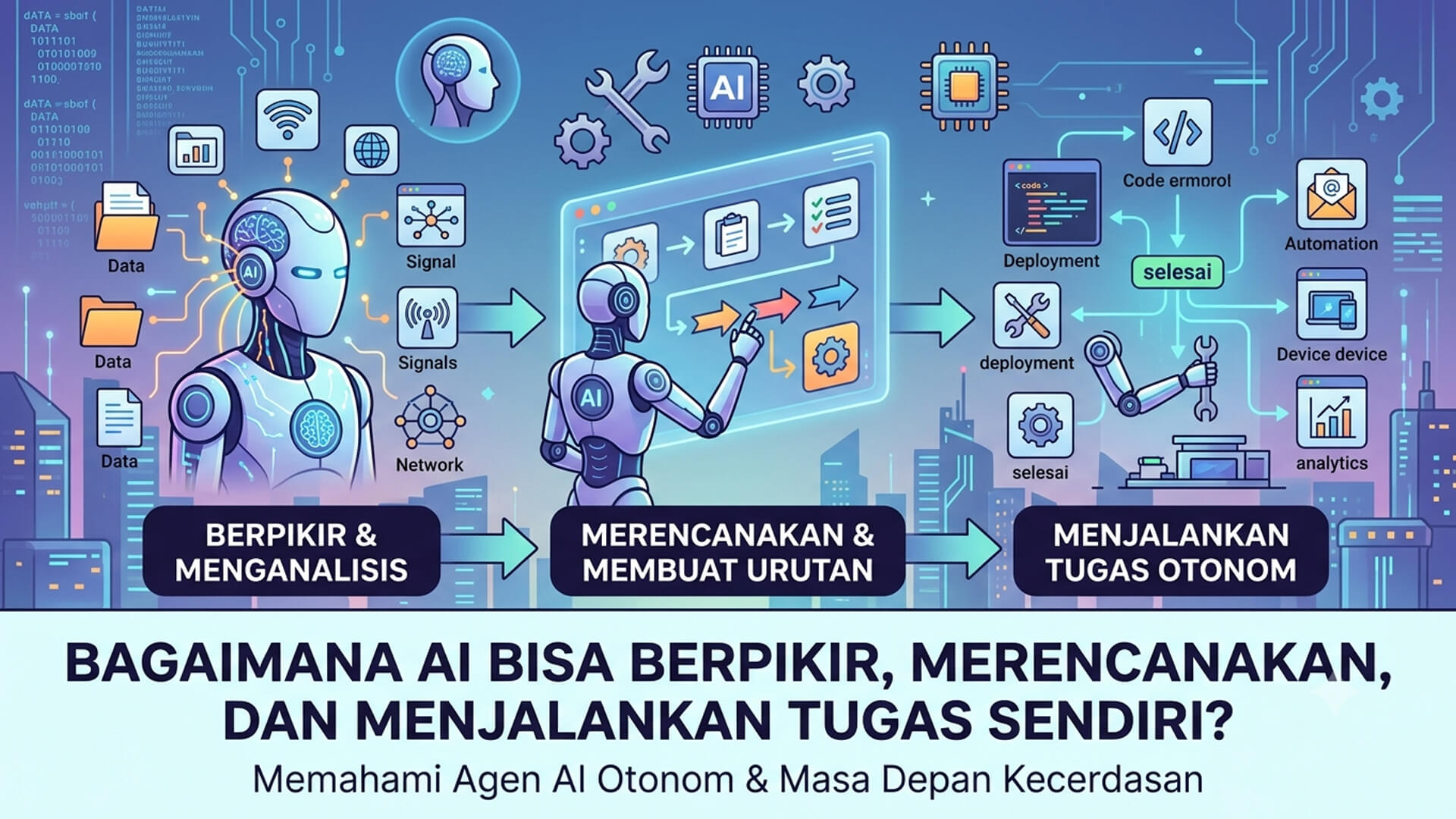
Artificial Intelligence (AI) has rapidly evolved from simple data processing systems into dynamic entities capable of interacting with their environments. In the modern tech landscape, the focus of AI development is no longer just on answering questions or generating text based on prompts. A major transformation is underway toward Agentic AI or autonomous AI, which possesses the ability to think, plan actions, and execute complex tasks independently. Understanding this phenomenon is crucial for technology professionals and business leaders alike, as it redefines automation, exponentially increases operational efficiency, and unlocks previously unimaginable opportunities for innovation.
What is Agentic AI? Definition and Core Concepts
Simply put, Agentic AI refers to artificial intelligence systems designed to act as autonomous agents. Unlike conventional Large Language Models (LLMs) which are reactive—responding only after receiving a direct prompt—autonomous AI agents are proactive. These systems are equipped with internal feedback loops that enable them to analyze situations, break down large goals into manageable steps, make data-driven decisions, and utilize various digital tools to complete tasks without needing constant guidance from human users.
Key Functions of Autonomous AI Agents
To operate independently, an Agentic AI system must possess several core capabilities:
- Strategic Planning: The ability to formulate a logical roadmap or sequence of actions to achieve complex goals, including the capacity to revise plans when encountering obstacles mid-way.
- Tool Integration and Use: The ability to interact with APIs, databases, web browsers, and external applications to gather information or execute digital and physical commands directly.
- Short-Term and Long-Term Memory: The ability to retain the context of current interactions (short-term memory) and store historical knowledge from past tasks (long-term memory) to improve future performance.
- Self-Reflection and Evaluation: The ability to critically assess their own outputs, detect errors in code or logic, and correct those mistakes before presenting the final result to the user.
Steps to Implement Agentic AI
Building and deploying autonomous AI agents within an organization's workflow requires a systematic approach:
- Goal and Constraint Definition: The initial step involves setting specific objectives for the agent and establishing clear ethical, security, and budgetary boundaries that must not be crossed.
- Foundation Model Selection: Choosing a powerful large language model or multi-modal AI model as the agent's core brain, ensuring it has high reasoning and instruction-following capabilities.
- Memory and Tool Architecture Design: Integrating the agent with vector databases for long-term memory and providing access to external tools like databases or search APIs.
- Reasoning Loop Development: Implementing structured reasoning frameworks so the agent can think step-by-step before taking action.
- Testing and Iterative Evaluation: Simulating tasks in controlled environments to evaluate the accuracy of the agent's decisions and refine system prompts.
Advantages of Deploying Agentic AI
Implementing autonomous artificial intelligence agents delivers significant benefits to the business and technology ecosystem:
- High Operational Efficiency: Agents can work continuously around the clock to complete complex administrative and operational tasks with minimal human intervention.
- Unmatched Scalability: Organizations can easily replicate AI agents to handle spikes in workload without the immediate need to recruit and train new staff.
- Objective Data-Driven Decisions: AI agents analyze thousands of data variables in real-time to execute the most optimal actions, free from human emotional bias.
- Empowered Human Creativity: By offloading routine and procedural tasks to autonomous agents, human employees can focus their energy on strategic innovation and interpersonal relationships.
Conclusion
The ability of AI to think, plan, and execute tasks autonomously marks a monumental shift from passive computation to active automation. By combining strategic planning, tool integration, adaptive memory, and self-reflection, Agentic AI has become a cornerstone of digital transformation. Adopting this technology is no longer just an option, but a strategic necessity to remain competitive in the future landscape.