Have LLMs Reached Their Limit? The Era of Reasoning Models Begins
Introduction: At the Limits of AI Scaling
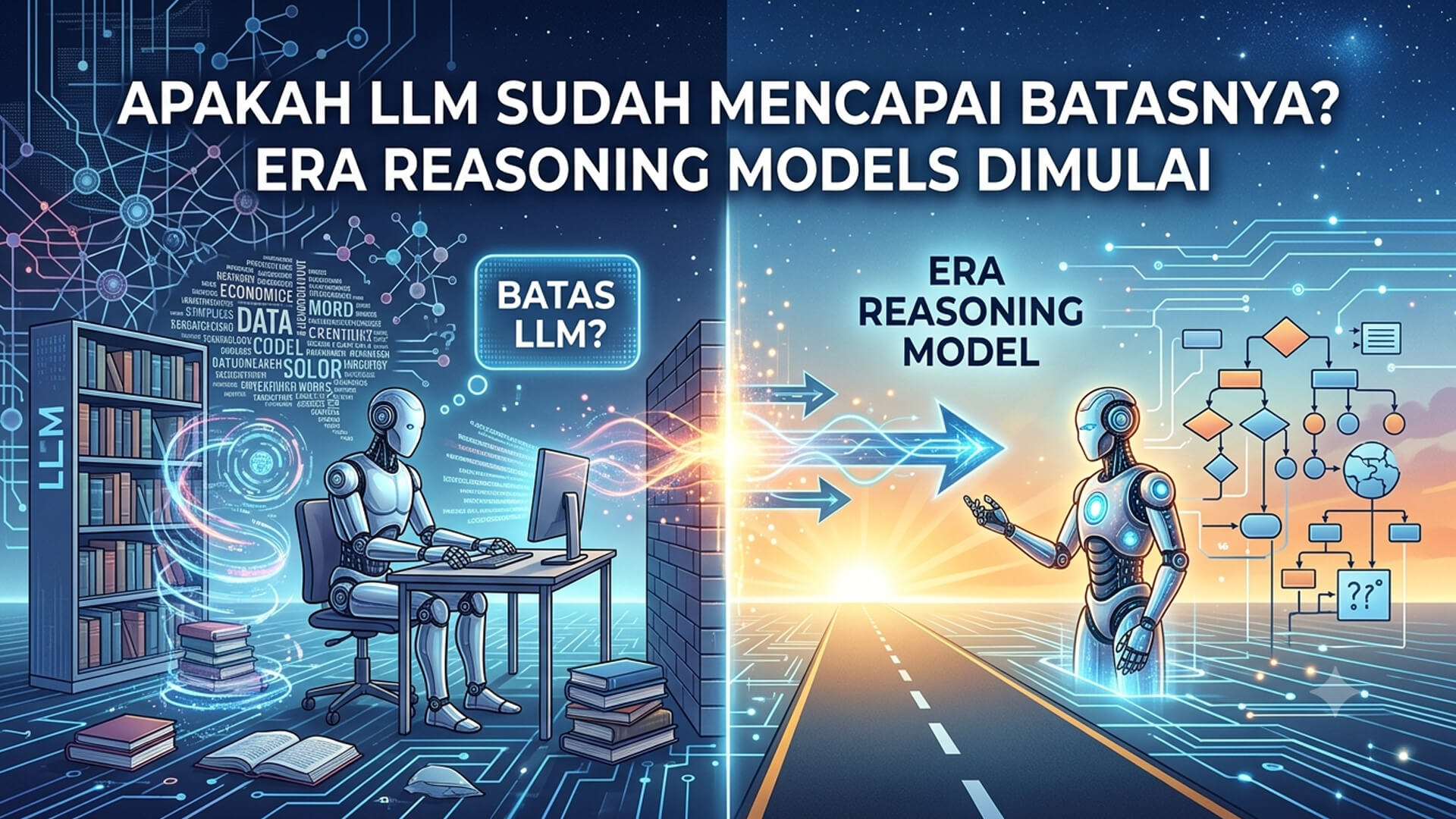
The artificial intelligence (AI) industry has experienced exponential growth in recent years, largely driven by the widespread success of traditional Large Language Models (LLMs). Since the emergence of the Transformer architecture, the dominant paradigm for enhancing AI intelligence has been to increase model size, train on more massive datasets, and provide greater computational power—a principle widely known as scaling laws. However, the technology community is now beginning to confront the reality that this 'bigger is better' approach is hitting a wall. The law of diminishing returns is becoming apparent, where adding hundreds of millions of dollars worth of parameters only yields marginal improvements in high-level reasoning tasks. This phenomenon has sparked a critical question among tech practitioners and global researchers: Have LLMs reached their physical limits? This question is not mere skepticism, but rather a catalyst to search for a new paradigm. In this dynamic landscape, the industry's focus is shifting dramatically from simple predictive text generation to the development of systems capable of slow, deep, and deliberate thought—a transition that marks the beginning of the era of Reasoning Models.
Defining Reasoning Models: Understanding the Slow-Thinking Paradigm
Reasoning Models represent the latest generation of artificial intelligence, designed not just to predict the next word in a sentence quickly and intuitively (often referred to as System 1 thinking in cognitive psychology), but to perform structured, deliberate, and multi-step logical reasoning before delivering an answer (System 2 thinking). Unlike traditional LLMs that generate instant responses directly, reasoning models utilize internal mechanisms such as dynamic Chain of Thought, tree search, and intensive reinforcement learning during the inference process. Through this architecture, the model can break down highly complex problems into smaller sub-problems, test various hypotheses, independently evaluate its own logical errors, and correct its path before presenting the final result to the user. In short, if a standard LLM acts like a fluent and spontaneous speaker, a reasoning model acts like a scientist or analyst who ponders, plans, and validates every argument before speaking.
Key Functions of Reasoning Models
In practice, reasoning models bring a suite of new capabilities that fundamentally distinguish them from first-generation generative AI models. Here are at least four key functions of these reasoning models:
- Solving Complex Mathematical and Logical Problems: These models are capable of solving advanced mathematical equations, proving theorems, and tackling logical puzzles that require multi-layered deduction. The AI does not merely memorize answer patterns but actually reconstructs the logical steps of the solution mathematically.
- Advanced Code Generation and Debugging: Beyond writing simple syntax, reasoning models can design software architectures, logically debug code by simulating its execution within their cognitive processes, and perform complex algorithmic optimizations for computational efficiency.
- Formulating Business Strategies and Multivariate Analysis: In business scenarios, these models can evaluate conflicting market variables, simulate the long-term impact of strategic decisions, and formulate risk mitigation scenarios by deeply analyzing cause-and-effect relationships.
- Scientific Research and Deep Literature Synthesis: Reasoning models assist researchers by analyzing scientific hypotheses, identifying anomalies in experimental data, and connecting concepts across diverse disciplines to design promising new experiments.
Implementation Steps for Reasoning Models
Adopting and integrating reasoning models into an organization's technological infrastructure requires a systematic approach to ensure optimal results and cost efficiency. Here are the structured steps for implementation:
- 1. Identify the Right Use Cases: The first step is to map your business problems. Avoid using reasoning models for simple tasks like basic text extraction or standard customer service due to the high computational (inference) costs. Focus on areas requiring critical decisions, complex logic, or advanced programming.
- 2. Prepare Infrastructure and APIs: Connect your systems to leading reasoning model API providers that support inference-time compute. Ensure your infrastructure can handle higher latency, as these models require seconds to minutes to think through their answers before delivering a response.
- 3. Design Chain-of-Thought Prompting: Create instructions that explicitly prompt the model to lay out its thinking process. While modern reasoning models have this capability built-in, providing structural guidance on how the reasoning should be presented will significantly improve the accuracy of the output.
- 4. Integrate a Feedback Loop: Implement automated and human-in-the-loop evaluation systems to monitor the quality of the model's reasoning. Use reasoning token logs to track where the model's logic failed if an error occurs, and use this data to refine future instructions.
- 5. Optimize Cost and Latency: Since reasoning models use more internal tokens to 'think', manage costs by limiting the maximum number of reasoning tokens allowed per task, and combine them with cheaper traditional LLMs for non-critical tasks within a hybrid architecture.
Advantages and Benefits of Reasoning Models
The transition to the era of reasoning models delivers a transformative impact on operational efficiency and the quality of AI outputs. Here are the key advantages offered by this technology:
- Significant Accuracy and Reduced Hallucinations: By evaluating and self-correcting during the thinking process, reasoning models dramatically reduce the occurrence of 'hallucinations' (convincing but false information) that often plague traditional LLMs.
- Out-of-Distribution Generalization (Zero-Shot Capability): These models do not just rely on pattern matching from past training data; they use fundamental reasoning principles to solve novel problems they have never encountered before in their training datasets.
- Transparency of the Thought Process (Reasoning Trace): Users can directly view the logical steps taken by the AI before it reaches a final conclusion. This provides auditability and builds trust in sensitive sectors such as medicine, law, and finance.
- Higher Learning Efficiency: Instead of requiring trillions of additional parameters to boost intelligence, reasoning models achieve high performance through smarter computation at inference time, paving the way for more environmentally friendly and resource-efficient AI development in the long run.
Conclusion: The Future of Artificial Cognition
Ultimately, the shift from traditional Large Language Models to Reasoning Models marks a crucial new chapter in the evolution of artificial intelligence. Raw data and parameter scaling may have reached their point of diminishing utility, but reasoning computation is just beginning. By giving AI the ability to 'think before it speaks,' we are not only building smarter machines but also more reliable, transparent, and capable partners to help humanity solve its greatest challenges. This new era promises a transition from fluent writing assistants to strategic thinking partners.