AI Agents, RAG, and MCP: Must-Understand Technologies in 2026
1. Introduction
Entering 2026, the global technological landscape is undergoing a highly significant paradigm shift, driven by the evolution of artificial intelligence (AI) from passive generative language models into active, autonomous systems. In recent years, the limitations of traditional AI models - such as data hallucination and the inability to interact with external systems in a standardized manner - have been the primary challenges to enterprise adoption. To overcome these hurdles, the tech industry is now integrating three key innovations: AI Agents, Retrieval-Augmented Generation (RAG), and the Model Context Protocol (MCP). The synergy of these three technologies not only improves the accuracy of AI responses but also enables them to act independently and collaborate within complex computing environments. For tech professionals, developers, and business leaders, understanding the close relationship between these three is an absolute necessity to maintain a competitive edge in this fast-paced era of digital transformation.
2. Definition of Technologies
To fully comprehend the potential of this modern architecture, we must analyze each component in depth:
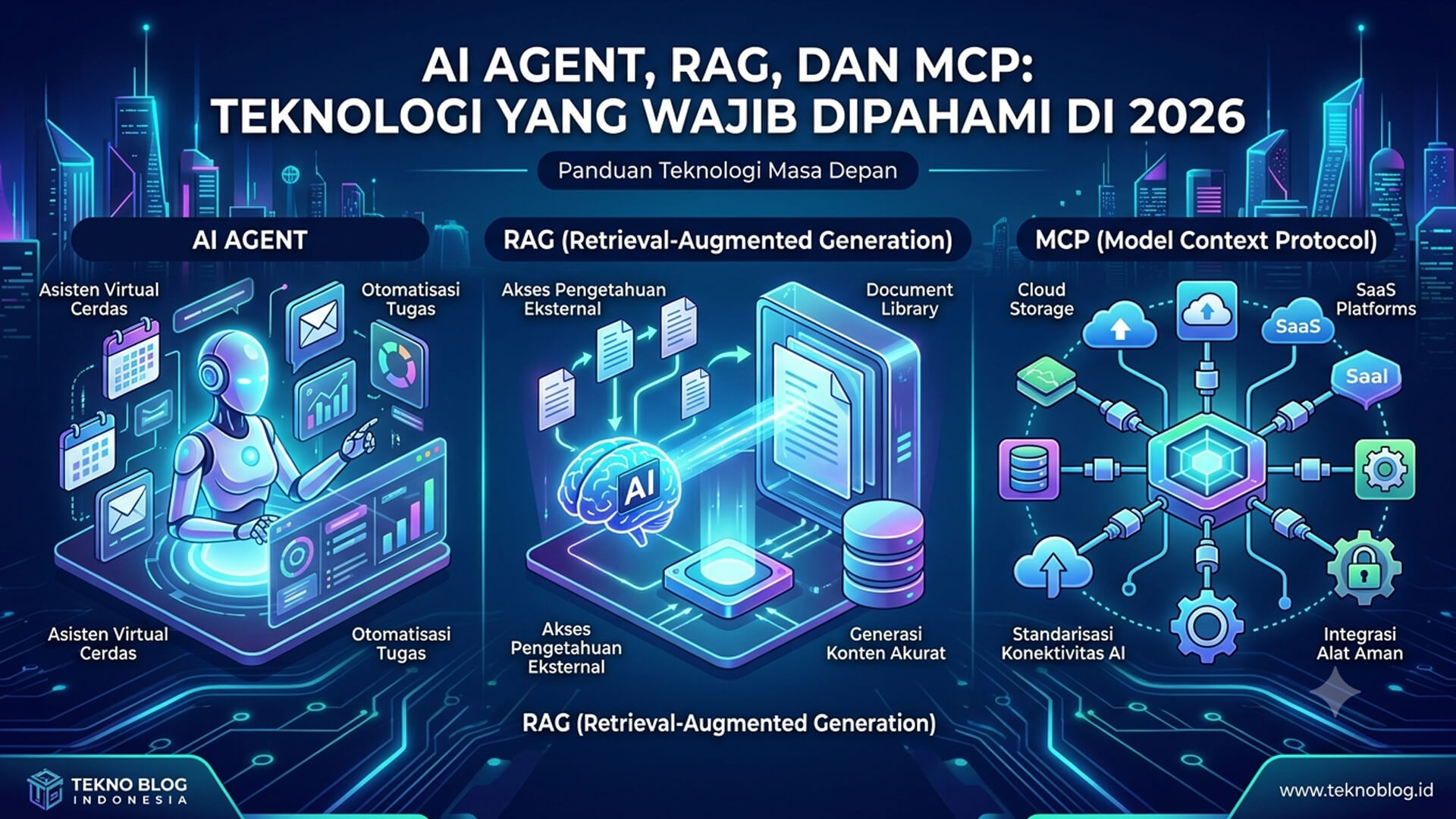
AI Agent: An artificial intelligence-based software entity designed to perform specific tasks autonomously. Unlike conventional chatbots that only respond to direct prompts, an AI Agent has the ability to analyze situations, plan problem-solving steps, utilize external tools, and evaluate its own performance to achieve the ultimate goals set by the user.
Retrieval-Augmented Generation (RAG): An architectural method that enhances the capabilities of LLMs (Large Language Models) by connecting them to dynamic, external knowledge sources, such as corporate databases, internal documents, or the web. RAG works by retrieving relevant information first before sending the prompt to the AI model, ensuring that the generated response is always grounded in current facts and free from hallucinations.
Model Context Protocol (MCP): An open-standard protocol introduced to facilitate secure, efficient, and uniform communication between AI models and various data sources or third-party tools. MCP acts as a universal bridge, replacing complex custom API integrations with a single communication standard that allows the AI to access files, databases, and external APIs directly without writing repetitive integration code.
3. Key Functions
The integration of these three components produces an intelligent computing ecosystem with the following core functions:
- Autonomous Decision Making: AI Agents use internal reasoning to break down complex tasks into sub-tasks that can be solved sequentially without continuous human intervention.
- Real-Time Context Provisioning: RAG ensures that the AI always has access to the most up-to-date and specific data, eliminating the knowledge cutoff limitations of base models.
- Universal Interoperability: MCP provides a standardized framework so that a single AI model can instantly and securely connect with various development tools, local databases, and cloud services.
- Significant Hallucination Reduction: By combining factual validation from RAG with standardized data access from MCP, AI Agents can generate highly accurate outputs with verifiable sources.
4. Implementation Steps
Building a system that integrates AI Agents, RAG, and MCP requires a structured approach. Here are the practical steps to implement it in your project:
Step 1: Requirements Analysis and Model Selection: Define the specific goals you want your AI Agent to achieve. Select a Large Language Model (LLM) that supports function calling and has high compatibility with the MCP protocol.
Step 2: Building the RAG Infrastructure: Set up a vector database (such as Pinecone, Weaviate, or pgvector) to store numerical representations (embeddings) of your organization's internal documents. Implement a data pipeline that automatically updates the vector index when source documents change.
Step 3: Configuring the Model Context Protocol (MCP): Install and configure the MCP server that fits your needs. Define data access schemas and security permissions that limit which directories or APIs the AI Agent can read or write to protect sensitive data privacy.
Step 4: Creating the Agentic Loop: Implement an agent framework (such as LangChain, CrewAI, or AutoGen) to manage the autonomous workflow. Write system prompts that instruct the agent on how to use RAG for information gathering and how to leverage MCP tools to execute concrete actions.
Step 5: Testing, Evaluation, and Iteration: Conduct real-world scenario tests to evaluate system performance. Analyze whether the agent successfully retrieves correct data via RAG and interacts securely via MCP, then adjust prompts and database architecture for optimal results.
5. Key Advantages
Adopting this integrated technology ecosystem brings several strategic advantages to your organization:
- High Operational Efficiency: The automation of end-to-end workflows by AI Agents minimizes manual involvement in repetitive administrative tasks.
- Information Accuracy and Security: RAG ensures decisions are based on factual organizational data, while MCP guarantees that data interactions are performed within strict, standardized security boundaries.
- Excellent System Scalability: Thanks to MCP's modular architecture, developers can easily add or replace new tools and data sources without rewriting the entire core application code.
- More Interactive User Experience: Users interact with a system that is not only smart at conversing but also capable of taking concrete actions, such as automatically updating databases or generating reports.
6. Conclusion
In 2026, the synergy between AI Agents, RAG, and MCP has redefined the standards of intelligent application development. The AI Agent acts as the autonomous brain that plans actions, RAG functions as the living memory that provides factual context, and MCP serves as the standardized hands that execute tasks in the digital world. Understanding and mastering the integration of these three technological pillars is an absolute necessity for developers and industry players who want to deliver efficient, secure, and futuristic technology solutions.