Will AI Agents Replace SaaS? Facts and Myths You Need to Know
Introduction: Why This Topic Matters in Modern Tech
The development of artificial intelligence (AI) has progressed from predictive systems into autonomous agents capable of interacting with and completing complex tasks. This phenomenon has sparked discussions among tech leaders regarding the future of subscription-based software, commonly known as Software as a Service (SaaS). Many are starting to analyze whether the era of traditional SaaS will shift and be replaced by independent AI Agents. Understanding the dynamics of this transition is important for software developers, business leaders, and investors to determine the direction of their technology investments and strategies.
Definition: What Are AI Agents and SaaS?
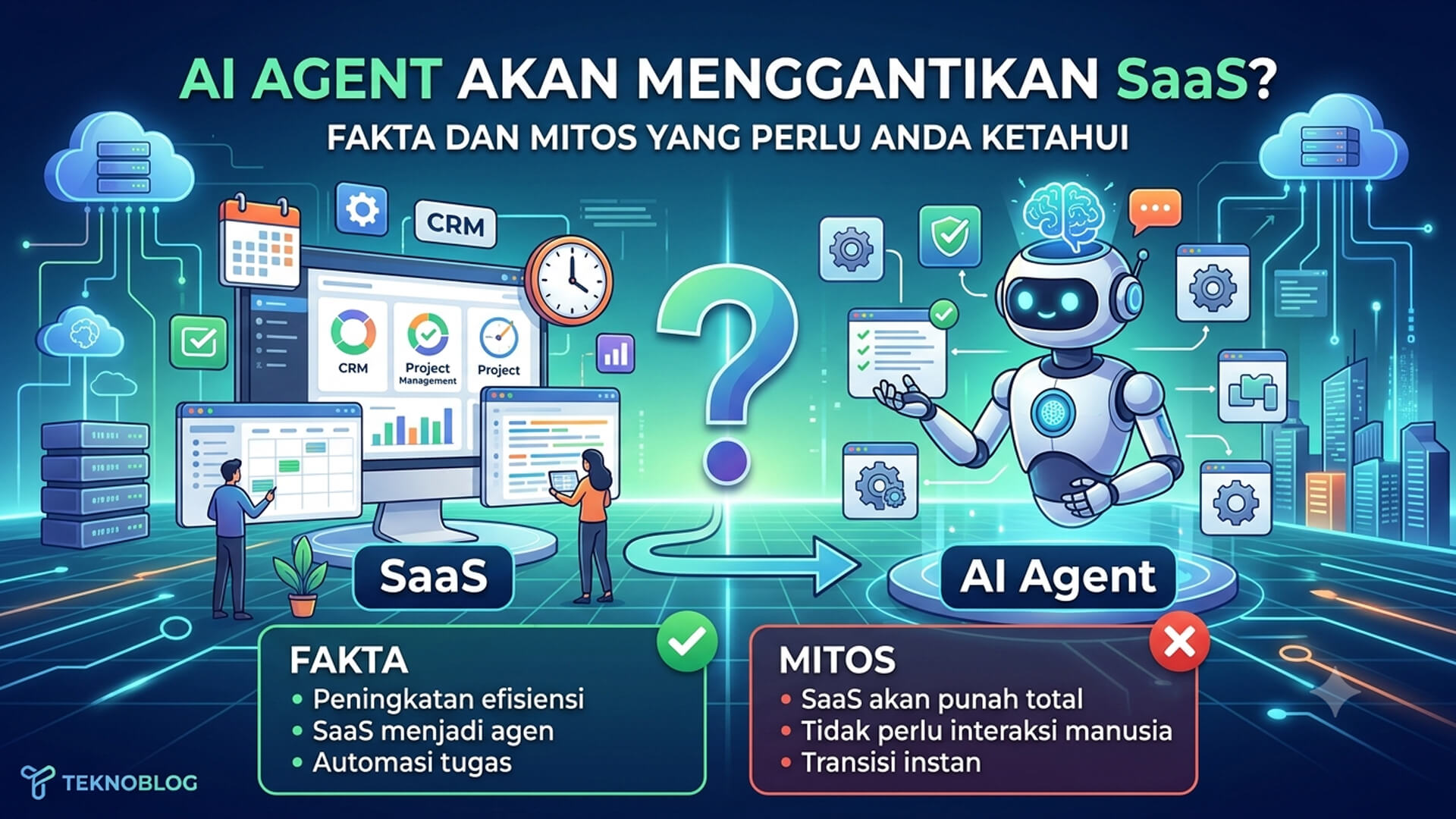
To understand this debate, we must clearly define both concepts. Software as a Service (SaaS) is a software distribution model where applications are hosted by a service provider and accessed by users over the internet. In the traditional SaaS model, the application acts as a static tool; human users must enter data and navigate interfaces to complete a task. In contrast, an AI Agent is an autonomous software system powered by a Large Language Model (LLM) that can plan actions, make decisions independently, utilize external tools via APIs, and achieve end goals without needing step-by-step human guidance.
Key Functions of AI Agents
- End-to-End Workflow Automation: AI Agents can manage and execute entire business workflows from start to finish, such as processing purchase orders, updating inventory, and sending customer confirmations automatically.
- Autonomous Decision-Making: Unlike conventional software, AI Agents can analyze business situations in real-time and make decisions based on predefined parameters, reducing reliance on direct human intervention.
- Cross-Platform Multi-System Integration: These intelligent agents can interact with various disparate SaaS platforms simultaneously through API integrations to synchronize and process data across platforms autonomously.
- Continuous Learning and Adaptation: Through feedback from past performance, AI Agents can continuously learn to improve their accuracy in subsequent tasks without requiring manual reprogramming.
Implementation Steps for AI Agents in Business
Integrating AI Agents into business operations requires a systematic approach to ensure operational success. Here are the essential steps to follow:
- 1. Identify the Right Business Processes: Look for workflows that are repetitive, have clear decision rules, yet involve high volumes of data processing, such as first-line customer support or financial data entry.
- 2. Choose AI Infrastructure and Frameworks: Select the foundational LLM to be used and choose agentic development frameworks like LangChain, CrewAI, or AutoGPT to build the agent's logic and autonomous capabilities.
- 3. Integrate Data Sources and API Access: Connect the AI Agent to internal company databases and third-party APIs so the agent has access to the data required to make decisions and take real-world actions.
- 4. Implement Human-in-the-Loop Protocols: Establish safe operational boundaries by requiring human approval for critical decisions or high-value financial transactions to prevent errors from AI hallucinations.
- 5. Test and Optimize Periodically: Perform testing in a sandbox environment before deploying the agent to the production system, and monitor its performance regularly to fine-tune the agent's prompts and logic parameters.
Key Advantages of AI Agents Over Traditional SaaS
- High Operational Efficiency: AI Agents can complete complex tasks in a short time that would normally take longer for humans to perform manually using conventional SaaS interfaces.
- Operational Scalability: Businesses can handle massive surges in transaction volumes or customer service requests instantly without needing to scale human headcount significantly.
- Data-Driven Personalization: AI Agents can analyze each customer's preferences and historical data instantly to deliver relevant responses and solutions in real-time.
- Reduced Human Error: With AI-driven logical automation, the risk of data entry errors or non-compliance with standard operating procedures can be reduced significantly.
Conclusion
The myth that AI Agents will completely eliminate the SaaS industry is inaccurate. The more realistic fact is a technological convergence, where traditional SaaS will evolve into platforms operated by AI Agents. AI Agents do not eliminate the need for SaaS software, but rather act as autonomous users that maximize the value of existing SaaS infrastructure to achieve optimal business productivity.