

Relational Database vs NoSQL: What Are the Differences?
Every application needs a place to store data. From user information and product catalogs to payment transactions, order histories, and user activities, all this information needs to be managed so it can be accessed whenever necessary.
In software development, there are many database technologies available. Two of the most commonly discussed approaches are Relational Databases and NoSQL Databases.
Relational databases have been a popular choice for application development for many years, especially for systems with clearly structured data and complex relationships. Meanwhile, NoSQL has become increasingly popular because it offers more flexible data storage models that support various modern application requirements.
But is NoSQL always better than a relational database? Do modern applications have to use NoSQL? Or is a relational database still the best option?
In this article, we will explore the differences between these two database approaches in simple terms, including their use cases, advantages, disadvantages, and how to choose the right database for your project.
1. What Is a Relational Database?
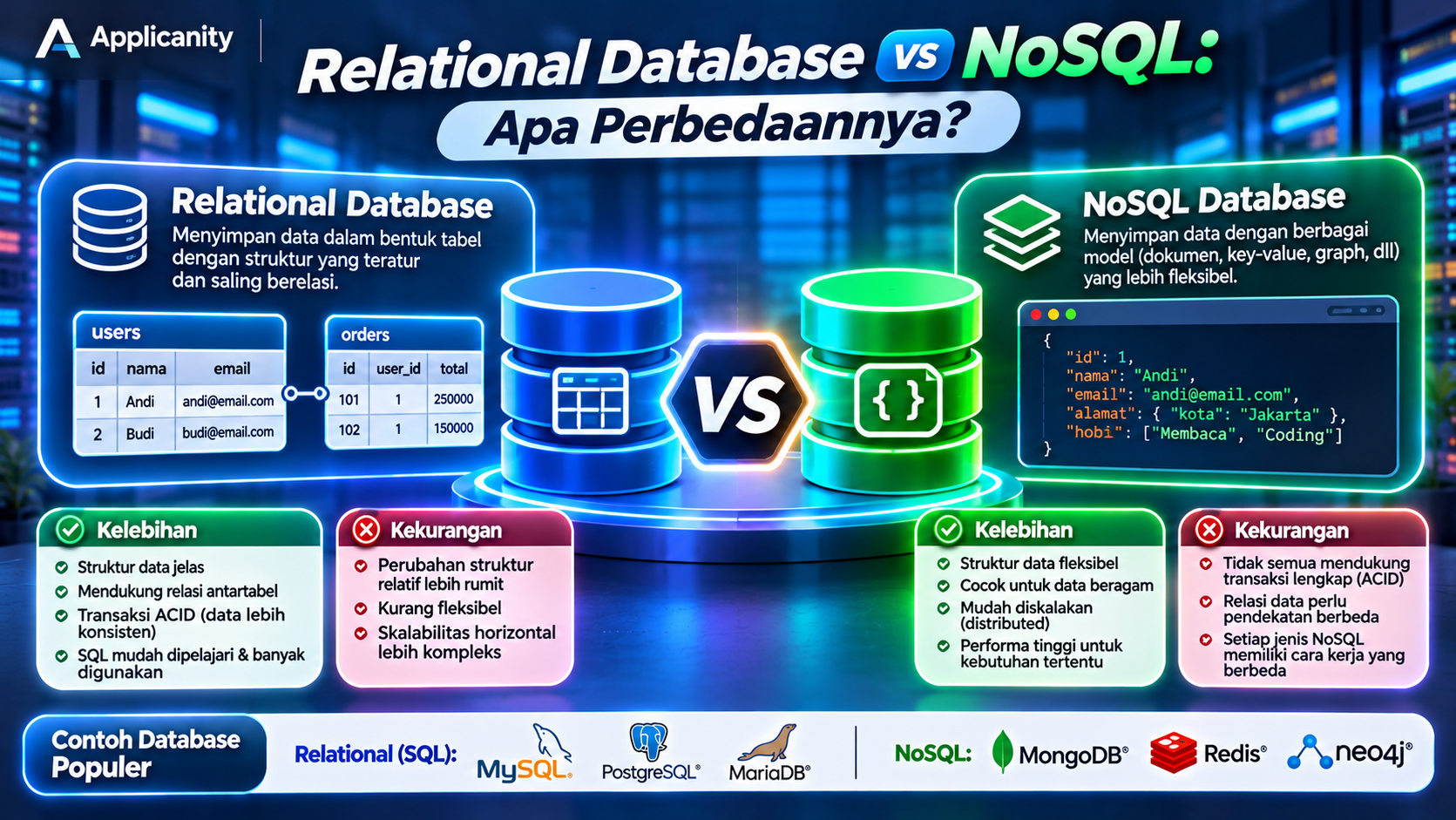
A Relational Database is a type of database that stores information in tables. Each table consists of rows and columns, similar to a spreadsheet in Microsoft Excel.
Each table generally has a predefined structure. Columns represent specific types of information, while rows contain individual records.
For example, an online store might have a users table with the following structure:
| id | name | |
|---|---|---|
| 1 | Andi | [email protected] |
| 2 | Budi | [email protected] |
| 3 | Citra | [email protected] |
In this example, each user is stored as a separate row, while id, name, and email represent the columns.
One of the main characteristics of a relational database is its ability to connect multiple tables through relationships.
For example, we can create another table to store customer orders:
Users table
| id | name |
|---|---|
| 1 | Andi |
| 2 | Budi |
Orders table
| id | user_id | total |
|---|---|---|
| 101 | 1 | 250000 |
| 102 | 1 | 150000 |
| 103 | 2 | 300000 |
The user_id column in the orders table connects each order to the user who placed it.
Through this relationship, the application can identify which orders belong to Andi or Budi without repeatedly storing the same user information in every order record.
This is one of the reasons relational databases are suitable for applications with many relationships between different types of data.
Examples of Relational Databases
Some popular relational database management systems include:
-
MySQL: Commonly used for websites, business applications, and content management systems.
-
PostgreSQL: Known for its extensive SQL features and support for complex data requirements.
-
MariaDB: A relational database that is compatible with MySQL in many aspects.
-
Microsoft SQL Server: Frequently used in enterprise systems and Microsoft environments.
-
Oracle Database: Often used for complex enterprise-level applications.
These databases generally use SQL (Structured Query Language) to manage and retrieve information.
2. What Is a NoSQL Database?
NoSQL is a database approach that does not require all data to be stored in relational tables like traditional SQL databases.
The term NoSQL is often explained as Not Only SQL. This means that NoSQL technologies are not limited to the relational model and can use different approaches to store information.
NoSQL databases are designed to handle various data structures with greater flexibility. This can be useful when an application has changing data requirements or information that does not always follow the same format.
For example, an application can store user information in a document format:
{
  "id": 1,
  "name": "Andi",
  "email": "[email protected]",
  "address": {
    "city": "Jakarta",
    "postal_code": "10110"
  },
  "hobbies": [
    "Reading",
    "Coding",
    "Gaming"
  ]
}
Unlike a relational database, the address and hobbies can be stored as part of the same user document.
This approach provides a more flexible data structure. Other user documents may contain additional attributes without requiring the entire collection to follow an identical structure, depending on the database's validation rules and capabilities.
Types of NoSQL Databases
NoSQL is not a single database type. It includes several data models, each designed for different requirements.
A. Document Database
Document databases store information as documents, usually in JSON or a similar format.
Examples:
-
MongoDB
-
CouchDB
This type of database is suitable for applications with flexible data structures, such as product catalogs, user profiles, and content management systems.
B. Key-Value Database
Key-value databases store information as pairs of keys and values.
For example:
user:1 = Andi
user:2 = Budi
user:3 = Citra
Each value can be retrieved using its corresponding key.
Examples:
-
Redis
-
Amazon DynamoDB
This model is commonly used for caching, session management, and storing data that needs to be retrieved quickly using a key.
C. Column-Family Database
Column-family databases organize information using groups of columns. This model is designed for large datasets and certain distributed data requirements.
Examples:
-
Apache Cassandra
-
ScyllaDB
These databases can be used in systems that distribute data across multiple servers and need to handle large workloads.
D. Graph Database
Graph databases store information as nodes and relationships between those nodes.
For example, a social media application contains users who follow one another. These relationships can be represented as a graph.
Examples:
-
Neo4j
-
Amazon Neptune
This model is useful for recommendation systems, relationship analysis, social networks, and discovering patterns between connected data.
3. Relational Database vs NoSQL: Key Differences
Although both technologies are designed to store and manage data, relational databases and NoSQL databases use different approaches.
Here are some of their main differences:
| Aspect | Relational Database | NoSQL Database |
|---|---|---|
| Data structure | Tables, rows, and columns | Documents, key-value, graph, or column-family |
| Schema | Generally structured and predefined | Can be more flexible, depending on the database |
| Data relationships | Supports relationships between tables | Relationships are handled through different approaches |
| Query language | Generally uses SQL | Uses queries or APIs depending on the product |
| Consistency | Generally supports ACID transactions | Varies; some support ACID while others use different consistency models |
| Scalability | Commonly strong with vertical scaling, but can also support horizontal scaling | Many products are designed for distributed and horizontal scaling |
| Common use cases | Transactions, finance, inventory, and business systems | Flexible data, caching, analytics, and distributed applications |
These differences do not mean one technology is always better than the other. Each has its own advantages and should be selected based on application requirements.
4. Advantages and Disadvantages of Relational Databases
Relational databases remain a popular choice for many applications because they provide structured data management and strong transaction capabilities.
Advantages of Relational Databases
A. Well-Organized Data Structure
Data is stored in tables with clearly defined columns and data types. This helps developers understand the database structure and maintain consistent information.
B. Supports Relationships Between Tables
Relational databases allow multiple tables to be connected using primary keys and foreign keys.
For example, a users table can be connected to orders, products, payments, and shipping addresses.
C. Supports ACID Transactions
One of the most important advantages of relational databases is their support for ACID transactions.
ACID stands for:
-
Atomicity: A transaction is completed as a whole or rolled back.
-
Consistency: Transactions must preserve data rules and consistency.
-
Isolation: Concurrent transactions should not produce unintended results.
-
Durability: Successfully committed data remains stored even if the system experiences a failure.
For example, when a customer makes a payment, the system needs to update the product stock and record the transaction. These operations must be handled correctly to avoid situations where a payment is recorded but the product stock remains unchanged.
D. SQL Is Widely Used
SQL is a well-established language supported by many relational databases. Many developers already have experience with SQL, making development and maintenance easier.
Disadvantages of Relational Databases
A. Data Structures Need Planning
Before storing information, developers usually need to define tables, columns, data types, and relationships.
Changing the structure of a large, existing database may require additional migration and testing.
B. Schema Changes May Require Additional Work
As an application grows, its database structure may need to change.
For example, a users table may initially contain only a name and email address. Later, the application may need additional information such as preferences, settings, or custom attributes.
These changes need to be managed through database migrations to avoid disrupting existing data.
C. Horizontal Scaling Can Be More Complex
Relational databases can use horizontal scaling, but implementation may become more complicated, especially when the system has many relationships, transactions, and consistency requirements.
However, modern relational database technologies provide various features to help address these requirements.
5. Advantages and Disadvantages of NoSQL Databases
NoSQL was developed to support different data storage requirements that do not always fit the traditional relational table model.
Advantages of NoSQL Databases
A. Flexible Data Structures
Some NoSQL databases allow documents to contain different attributes.
This is useful when application requirements frequently change or when information has different structures.
B. Suitable for Distributed Systems
Many NoSQL databases are designed to run across multiple servers.
With this approach, data and workloads can be distributed across several machines based on the product's capabilities and configuration.
C. Designed for Specific Data Models
Each NoSQL model has its own strengths.
For example, Redis is suitable for key-value storage, MongoDB for document storage, and Neo4j for managing relationships between data.
D. Can Support Changing Application Requirements
For applications that continue to evolve, flexible document structures can make it easier to add new attributes without changing an entire table structure.
Disadvantages of NoSQL Databases
A. Not Every Product Uses SQL
Each NoSQL database may have a different way of storing, retrieving, and managing information.
Developers need to learn the queries or APIs provided by the selected product.
B. Data Relationships May Require Different Approaches
In a document database, related information is often stored in the same document or connected through references.
This can simplify certain operations, but it may also introduce data duplication if the database design is not planned carefully.
C. Not All NoSQL Databases Work the Same Way
NoSQL includes several different database models. Transaction support, consistency, replication, and scalability can vary significantly between products.
Therefore, it is incorrect to assume that all NoSQL databases have identical capabilities or limitations.
6. Real-World Examples of Relational Database and NoSQL Usage
To better understand the differences, let's look at several application examples.
A. School Information System
A school information system usually manages related data such as:
-
Student information.
-
Teacher information.
-
Class information.
-
Subjects.
-
Student grades.
-
Attendance records.
For example, one student can take multiple subjects and have many grade records.
These data structures have clear relationships, making a relational database such as MySQL or PostgreSQL a reasonable choice.
B. E-Commerce Applications
An e-commerce application manages various types of information, including users, products, categories, orders, payments, and inventory.
Relational databases are suitable for managing transactions that require consistency, especially when payment processing and inventory updates must be coordinated.
However, NoSQL can also be used for specific requirements, such as storing product catalogs with highly varied attributes or handling user activity data.
C. Chat and Real-Time Applications
Chat applications handle continuous communication. They need to manage messages, online status, notifications, and user activities.
A database such as MongoDB can store message documents, while Redis can help manage temporary information such as user status or frequently accessed data.
However, database selection should still consider message storage, search requirements, message ordering, and data consistency.
D. Analytics and Monitoring Systems
Monitoring applications can generate large amounts of data, such as CPU usage, RAM usage, network traffic, and server activity.
Databases designed for distributed storage or time-series data may be suitable, depending on the write patterns and analytical requirements.
Not every analytics workload requires NoSQL. Relational databases can also handle many analytical tasks when the database design and infrastructure are appropriate.
7. When Should You Use a Relational Database?
A relational database is a good choice when an application has clearly structured data and requires relationships between tables.
Consider using a relational database when:
-
The application has many relationships between different data entities.
-
The system requires consistent transactions.
-
Data follows a relatively organized structure.
-
The application needs complex queries using JOIN operations.
-
The system manages finance, payments, inventory, or orders.
Examples of suitable projects include:
-
Academic information systems.
-
Point of Sale applications.
-
Accounting software.
-
Inventory management systems.
-
Banking applications.
-
ERP and CRM systems.
8. When Should You Use NoSQL?
NoSQL can be a good choice when an application needs a specific storage model, flexible data structures, or distributed capabilities that match its requirements.
Consider using NoSQL when:
-
Data structures change frequently.
-
Information comes in different formats.
-
The application needs a key-value, document, or graph data model.
-
The system needs to distribute data across multiple servers.
-
The access patterns are better suited to a particular NoSQL model.
Examples of projects that may use NoSQL include:
-
Caching systems.
-
Chat applications.
-
Recommendation systems.
-
Certain analytics platforms.
-
Sensor and monitoring data storage.
-
Applications with documents that have varying structures.
Keep in mind that NoSQL is not automatically the best choice for large-scale applications. Data design, access patterns, transaction requirements, and infrastructure capabilities remain important factors.
9. Can Relational Databases and NoSQL Be Used Together?
Yes. This approach is known as polyglot persistence, which means using more than one data storage technology within the same application or system.
Each database is selected for the requirements it handles best.
For example, an e-commerce application might use:
-
PostgreSQL for users, orders, payments, and inventory.
-
Redis for caching and session management.
-
MongoDB for specific document-based requirements with flexible structures.
With this approach, developers do not have to force every storage requirement into a single database technology.
However, using multiple databases also increases system complexity. Teams need to manage connections, security, backups, monitoring, data synchronization, and recovery processes for every technology.
Therefore, use this approach when there is a clear technical requirement, not simply because multiple database technologies are popular.
10. Conclusion: Which Is Better, Relational Database or NoSQL?
Relational databases and NoSQL databases have their own advantages and disadvantages. Neither option is always better for every type of application.
Relational databases such as MySQL and PostgreSQL are suitable for applications with clearly structured data, relationships between tables, and consistent transaction requirements.
Meanwhile, NoSQL databases such as MongoDB, Redis, Cassandra, and Neo4j provide different storage models for flexible data, distributed systems, caching, and complex relationship management.
Before choosing a database, consider the following factors:
-
The type of data you need to store.
-
Relationships between different data entities.
-
Access patterns and query requirements.
-
Transaction and consistency requirements.
-
Expected application growth.
-
Your team's ability to manage the technology.
For many business applications, a relational database such as MySQL or PostgreSQL is an excellent starting point. NoSQL can be introduced when the application has specific requirements that benefit from it.
Ultimately, the best database is not necessarily the most popular or newest technology. It is the one that fits your application's actual needs.
Applicanity helps businesses develop websites and applications using technologies that match their requirements, including database architecture that is structured, secure, and ready to grow.

